Skip to content

men's cuts · Diamond face · proportions only

Best haircuts for diamond-shaped faces (men), ranked by face-analysis data

The top 10 men's cuts from our catalog for a textbook diamond face, ranked by the same scorer that runs your analysis. Each one says why it works, when it doesn’t, what to tell your barber, and what it costs to keep.

Are you actually diamond?

Check in 10 seconds, in your browser. Your photo never leaves your phone.

Line drawing of a textbook diamond face with forehead, cheekbone, jaw and length measurement linesFWCWJWL

Our engine’s reading of this face

  • Diamond76%
  • Oval24%

How we classify a diamond face

Length ÷ width
about 1.35 to 1.5
Widest point
the cheekbones, by a lot
Cheekbone prominence
about 1.2 or more
Forehead ÷ jaw
close to 1.0; both narrow

The ratios: length ÷ width (LW), forehead ÷ jaw (FJ), cheekbone prominence (CK), jaw angularity (ANG). We report shape as a mix, never a single label, because the categories are a stylists’ convention with fuzzy borders. More on the diamond face shape.

The 10 men's cuts that do the most for diamond proportions

Proportion scores (0–100) from the engine’s geometry-only ranking. In a full analysis proportions are about 15% of the score; texture, density, hairline and your routine decide the rest.

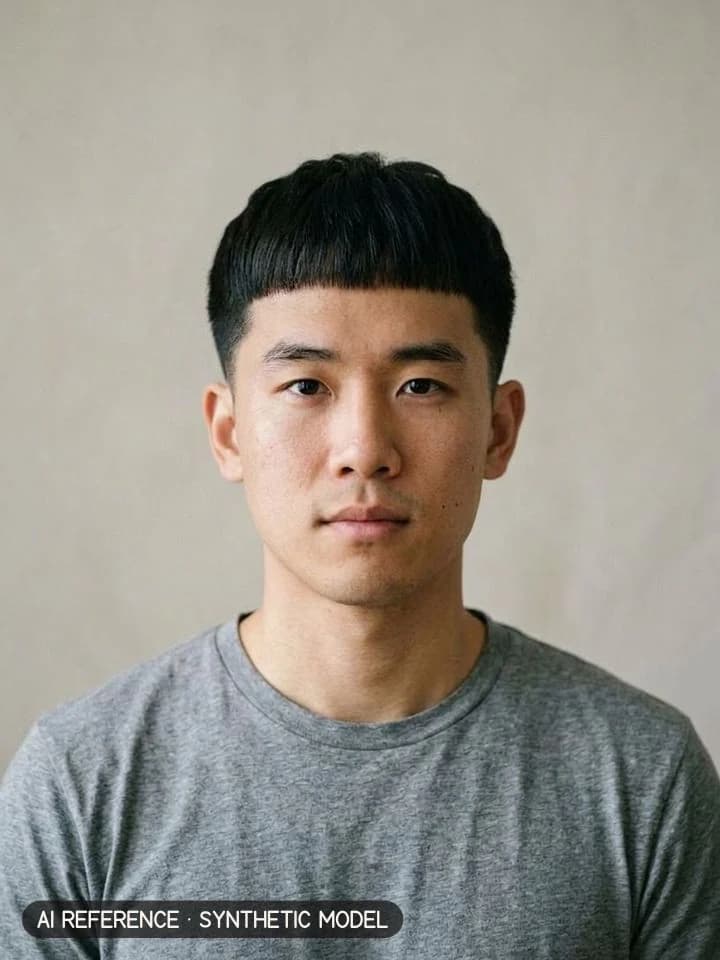
1. Edgar cut

57/100 proportion score

Best on 1A–2B · top 1–2 in (2.5–5 cm) · recut every 2–3 weeks

Why it ranks here

  • Keeps the cheek line slim, which balances prominent cheekbones.Stylist convention
  • Adds straight lines and sharp edges, which balances a soft, rounded jaw.Stylist convention

When it doesn’t work

  • A low forehead, a front cowlick, prominent ears (skin fade); the hard front line shows temple recession from stage 3; trend-dependent (Janif 2014).
  • 3B–4C hair (curly and coily): the shape depends on a texture it can't hold, so we rule it out.
  • Low-density hair: the cut relies on bulk that thin hair doesn't have.

Tell your barber

“High or mid skin fade (drop or burst optional); top 1–2 in, textured; blunt fringe cut straight across with a sharp line-up.”

  1. Skin0 mm
  2. #13 mm
  3. #26 mm

Upkeep: trim every 2–3 weeks, about $510–$780 a year at $30 a cut.
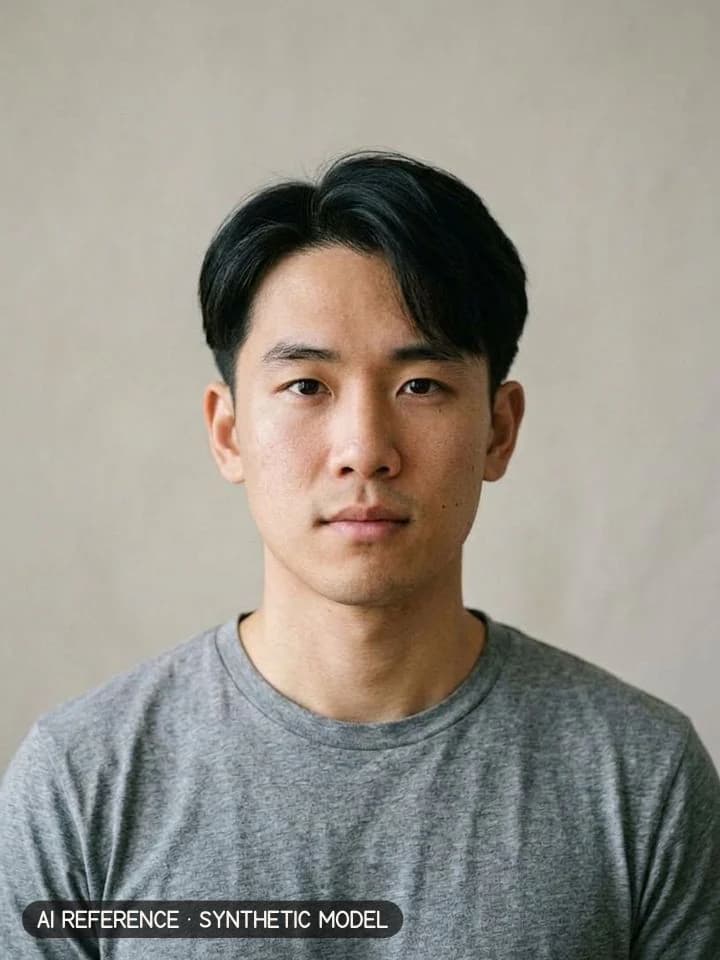
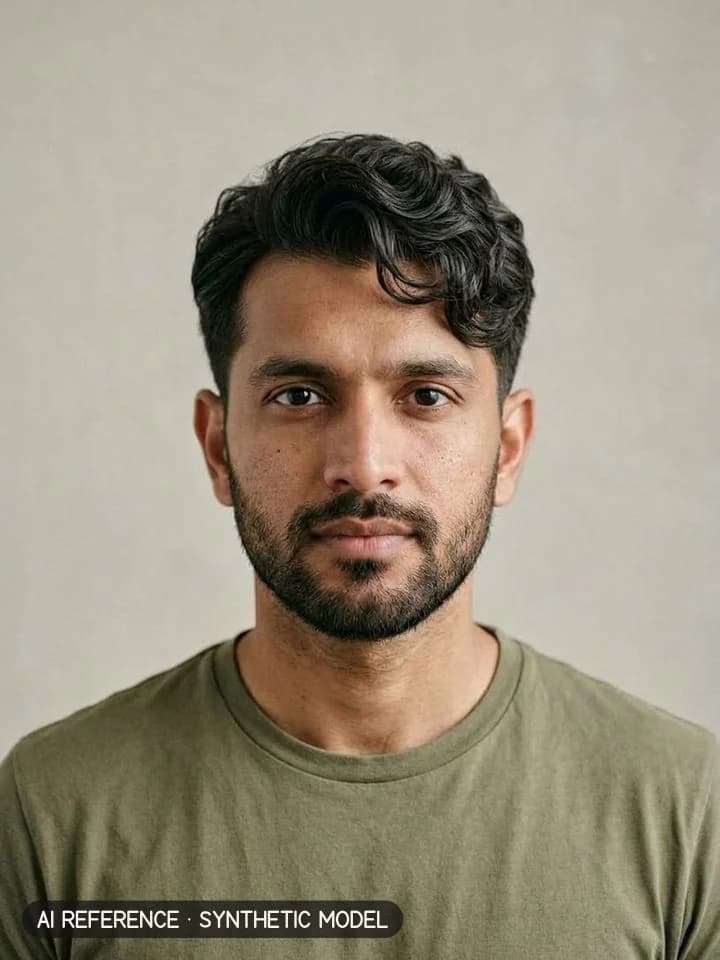
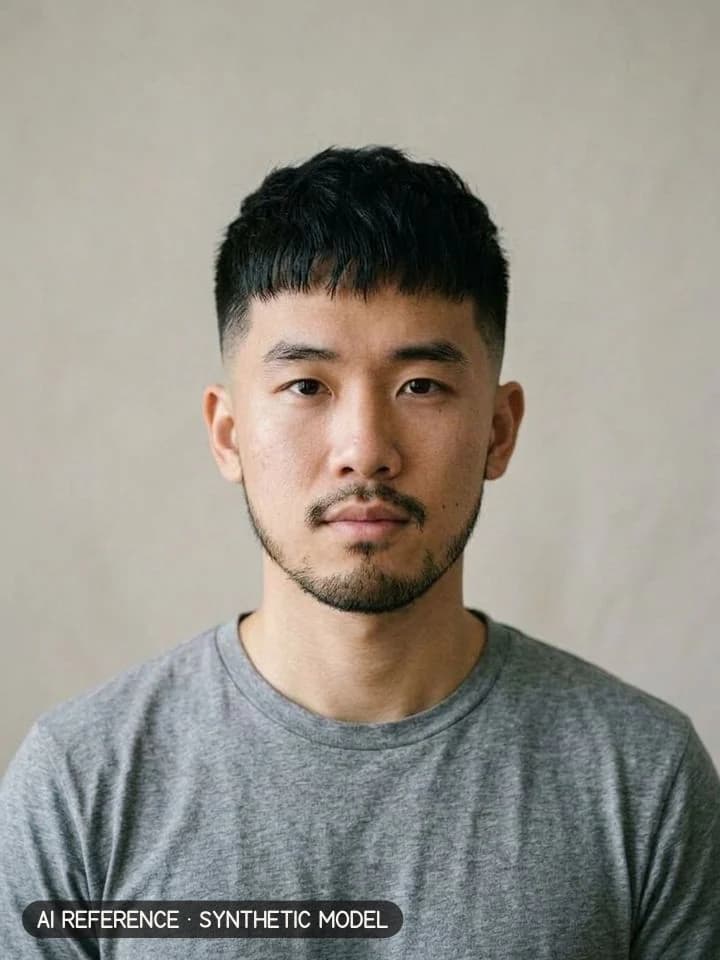
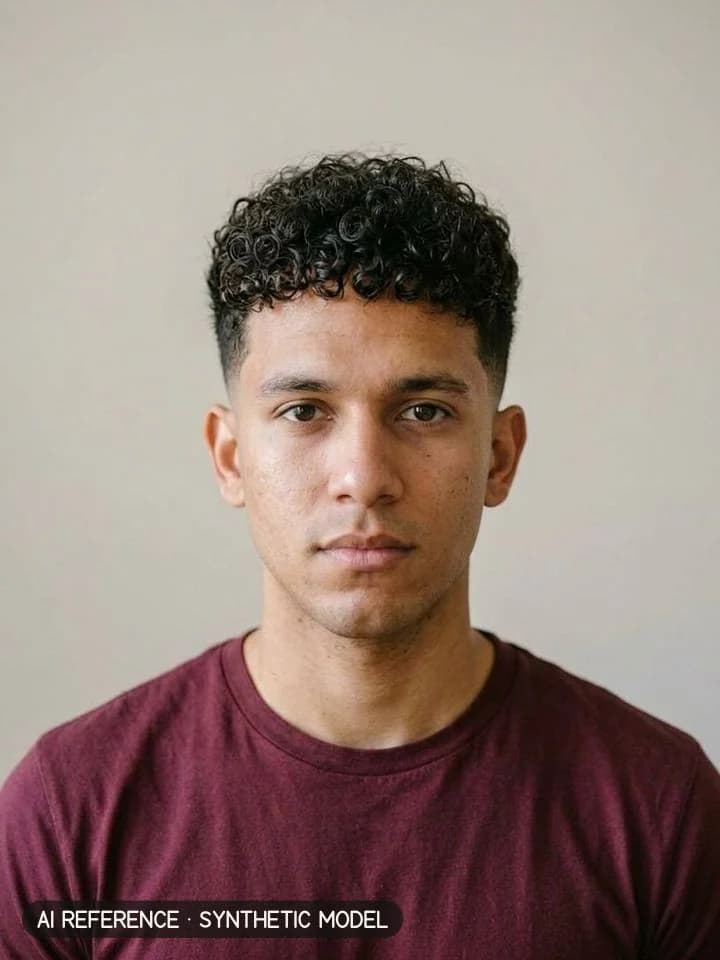
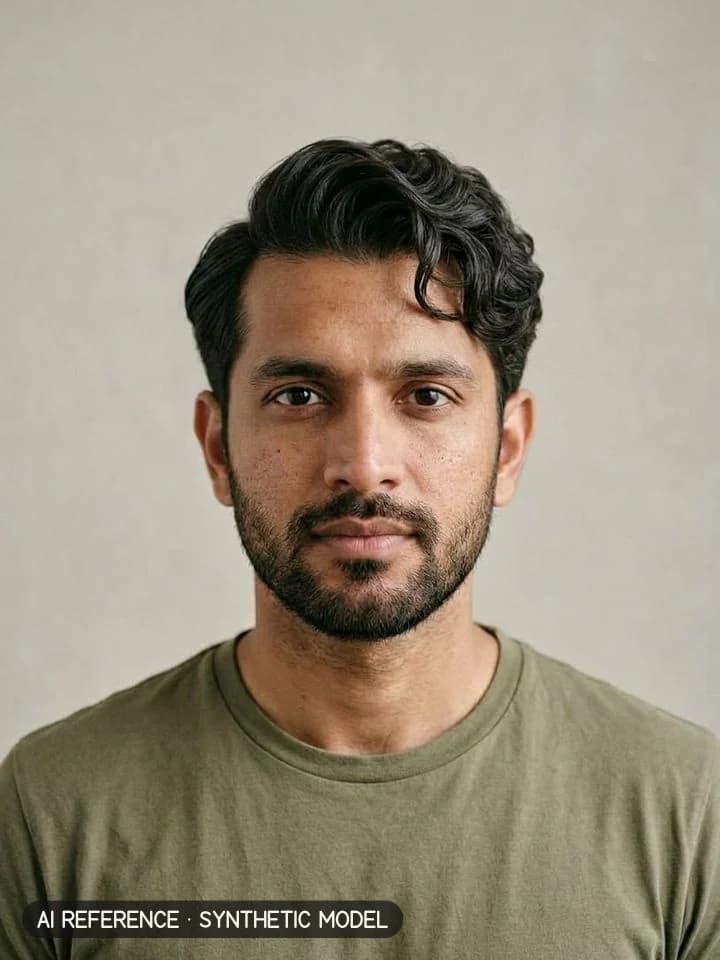
Edgar cut on Model M1 (light skin · straight 1B hair · 20s). AI reference on a synthetic model — not a real person.Edgar cut on Model M2 (fair skin · fine-wavy 2A hair with some gray · 40s). AI reference on a synthetic model — not a real person.Edgar cut on Model M3 (medium brown skin · thick wavy 2B–2C hair · 30s). AI reference on a synthetic model — not a real person.

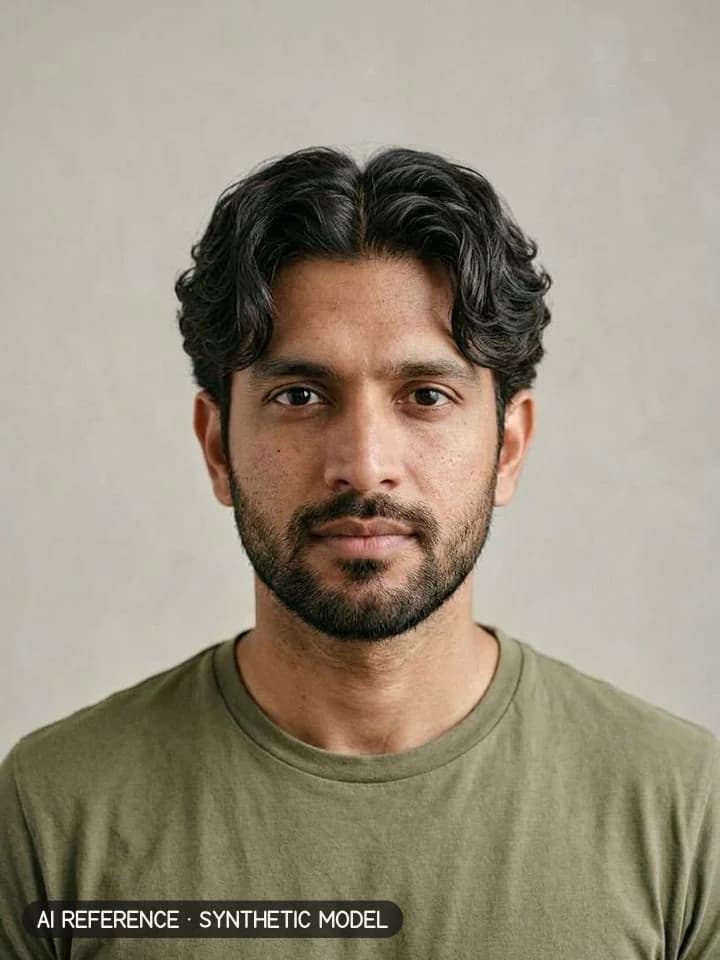
AI references on synthetic models, not real people

2. Buzz cut

56/100 proportion score

Best on 1A–4C · top 0.3–0.4 in (0.5–1 cm) · recut every 2–3 weeks

Why it ranks here

  • Adds straight lines and sharp edges, which balances a soft, rounded jaw.Stylist convention

When it doesn’t work

  • Puts bumps, a flat back of the head and prominent ears on show.
  • Scores lower if you have prominent ears.

Tell your barber

“#2 (6 mm) all over, or #3 top / #1 sides blended; tapered neckline; edge up.”

  1. #13 mm
  2. #26 mm
  3. #310 mm

Upkeep: trim every 2–3 weeks, about $510–$780 a year at $30 a cut.

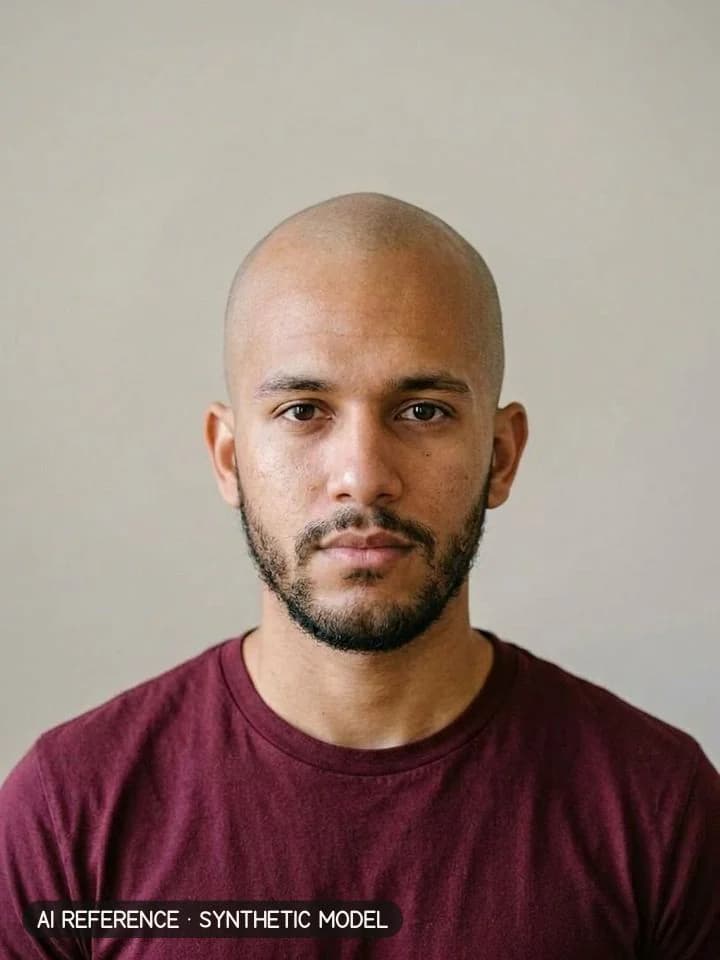
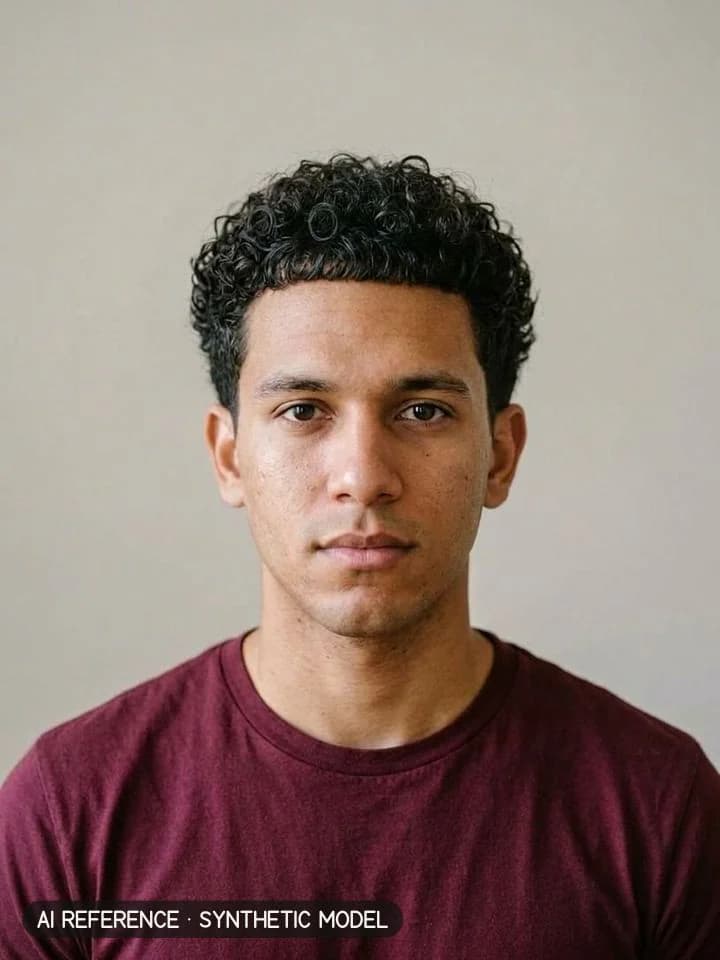
Buzz cut on Model M1 (light skin · straight 1B hair · 20s). AI reference on a synthetic model — not a real person.Buzz cut on Model M4 (deep brown skin · coily 4C hair · 30s). AI reference on a synthetic model — not a real person.Buzz cut on Model M5 (light brown skin · curly 3B–3C hair · 20s). AI reference on a synthetic model — not a real person.

AI references on synthetic models, not real people

3. Curtains / middle part

56/100 proportion score

Best on 1A–2C · top 4–6 in (10–15 cm) · recut every 4–6 weeks

Why it ranks here

  • Adds fullness at the temples, which balances prominent cheekbones.Stylist convention

When it doesn’t work

  • A prominent nose; an off-centre front cowlick; hidden from hairline stage 2.
  • 3B–4C hair (curly and coily): the shape depends on a texture it can't hold, so we rule it out.
  • Low-density hair: the cut relies on bulk that thin hair doesn't have.

Tell your barber

“Top 4–6 in, centre part; fringe falls to the temples; scissor or low-taper sides; texturize the ends.”

Upkeep: trim every 4–6 weeks, about $270–$390 a year at $30 a cut.

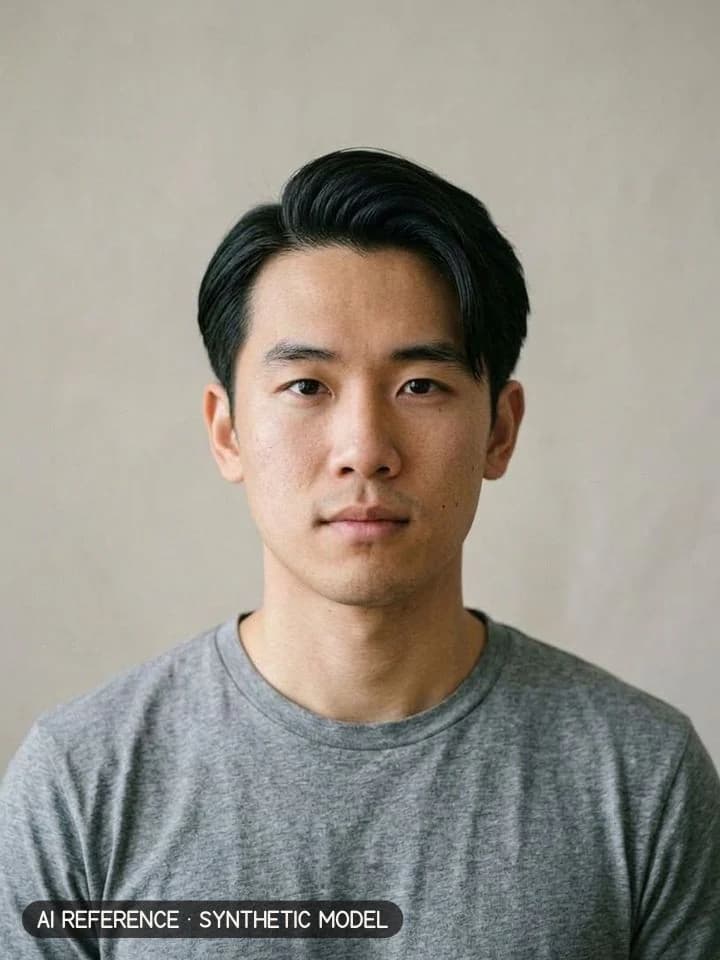
Curtains / middle part on Model M1 (light skin · straight 1B hair · 20s). AI reference on a synthetic model — not a real person.Curtains / middle part on Model M2 (fair skin · fine-wavy 2A hair with some gray · 40s). AI reference on a synthetic model — not a real person.Curtains / middle part on Model M3 (medium brown skin · thick wavy 2B–2C hair · 30s). AI reference on a synthetic model — not a real person.

AI references on synthetic models, not real people

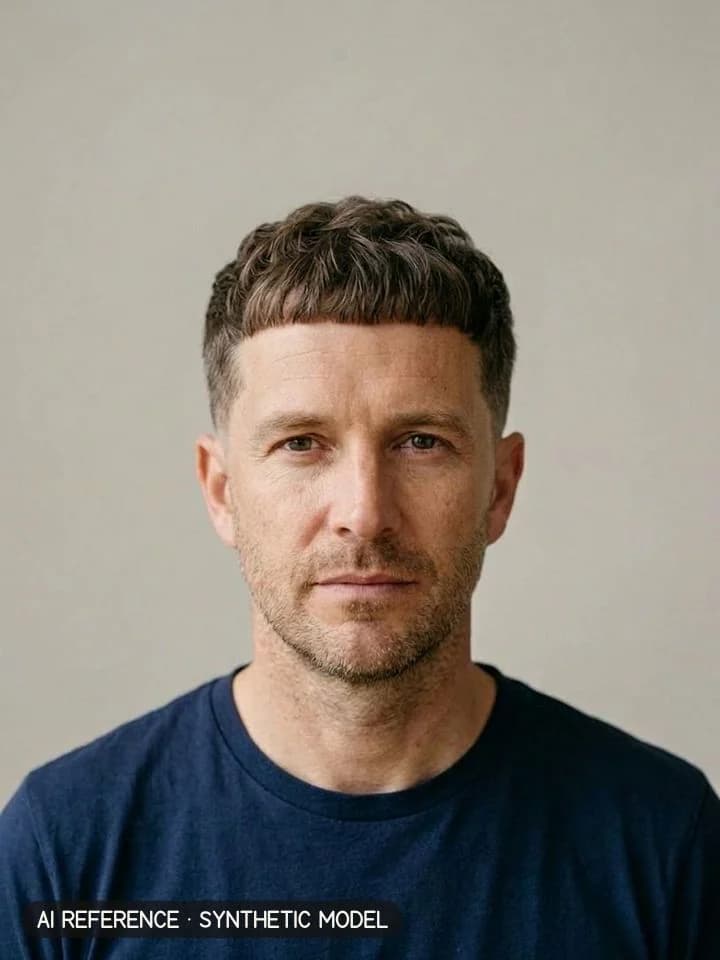
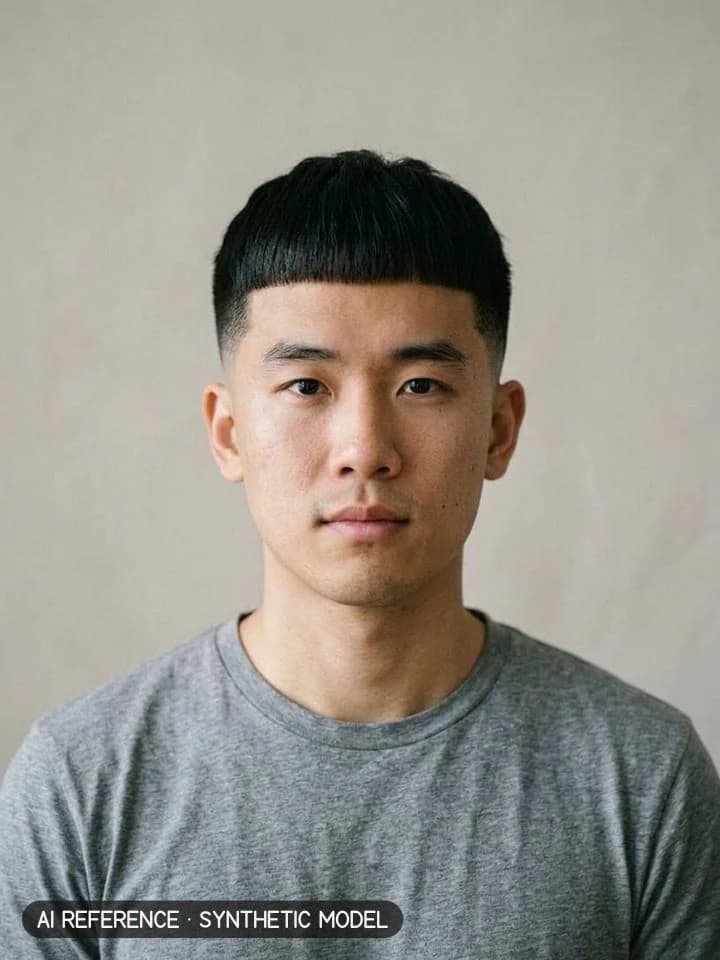
4. French crop

56/100 proportion score

Best on 1A–2C · top 1–2 in (2.5–5 cm) · recut every 3–4 weeks

Why it ranks here

  • Adds straight lines and sharp edges, which balances a soft, rounded jaw.Stylist convention
  • Shortens the overall line, which balances a longer face.Stylist convention

When it doesn’t work

  • A low forehead, a front cowlick, a round face without fade contrast.
  • 3B–4C hair (curly and coily): the shape depends on a texture it can't hold, so we rule it out.
  • A hairline past Norwood 3: at stage 4 it's shown with a caveat; beyond that we hide it.

Tell your barber

“Blunt straight fringe at mid-forehead; top 1–2 in; low or mid taper sides.”

Upkeep: trim every 3–4 weeks, about $390–$510 a year at $30 a cut.

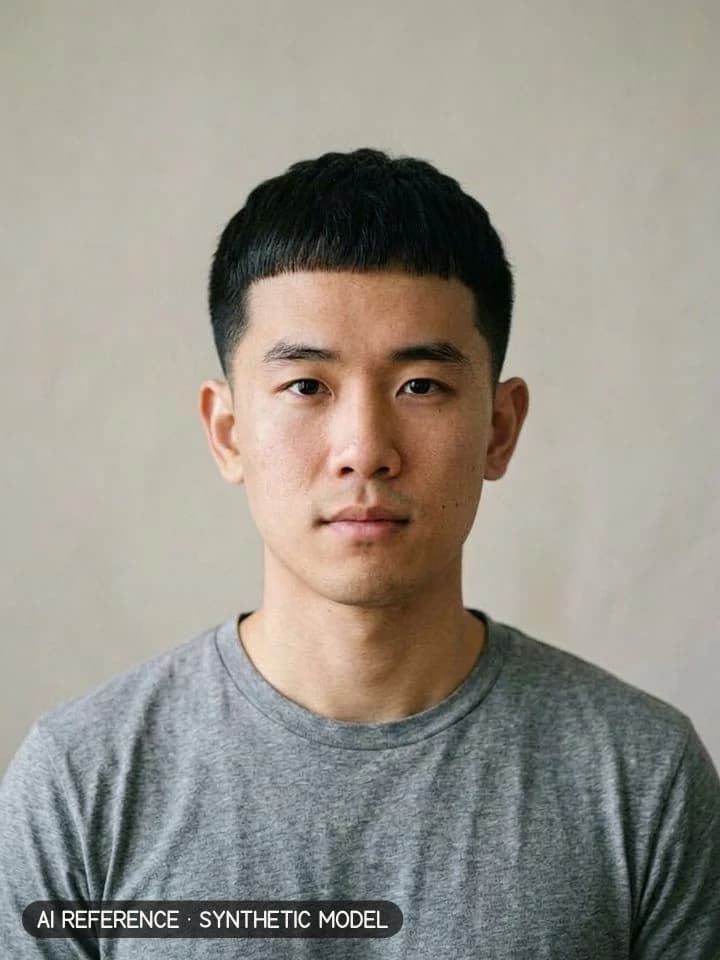
French crop on Model M1 (light skin · straight 1B hair · 20s). AI reference on a synthetic model — not a real person.French crop on Model M2 (fair skin · fine-wavy 2A hair with some gray · 40s). AI reference on a synthetic model — not a real person.French crop on Model M3 (medium brown skin · thick wavy 2B–2C hair · 30s). AI reference on a synthetic model — not a real person.

AI references on synthetic models, not real people

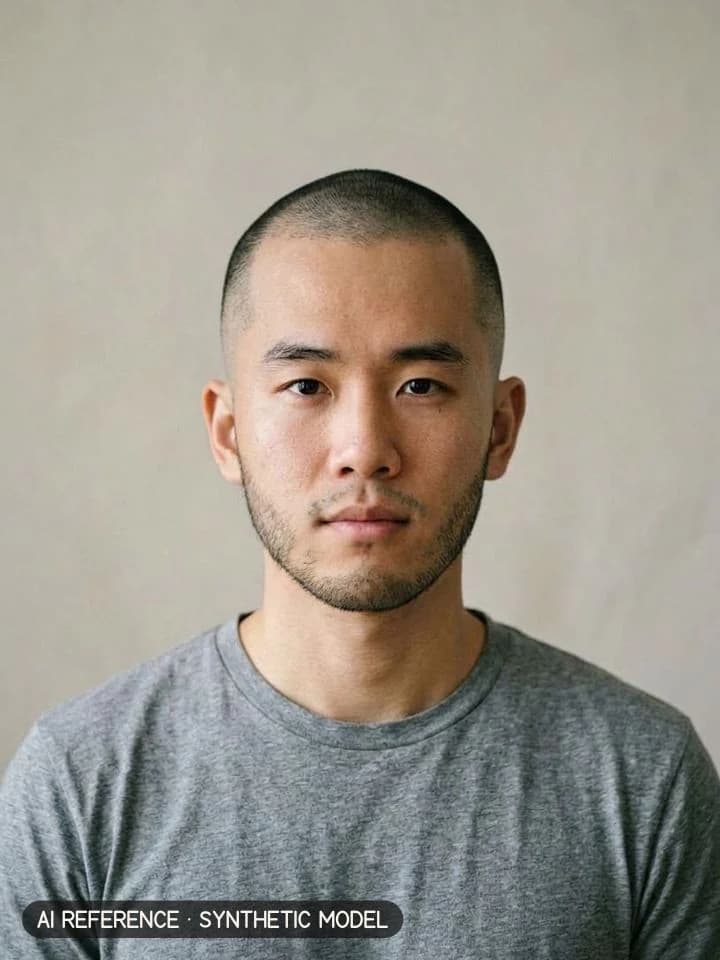
5. Shaved head / bald fade

55/100 proportion score

Best on 1A–4C · top 0–0.1 in (0 cm) · recut every 2–3 weeks

Why it ranks here

  • Adds straight lines and sharp edges, which balances a soft, rounded jaw.Stylist convention

When it doesn’t work

  • Shows an irregular skull shape or scars. Trade-off from a US study (Mannes 2013): a shaved head reads as more dominant and about 4 years older, and scored lower on looks than a full head of hair.
  • Scores lower if you have prominent ears.

Tell your barber

“Bald fade from 0 on sides; top foil or #0.5; blend into beard.”

  1. Skin0 mm
  2. #0.51.5 mm

Upkeep: trim every 2–3 weeks, about $510–$780 a year at $30 a cut.
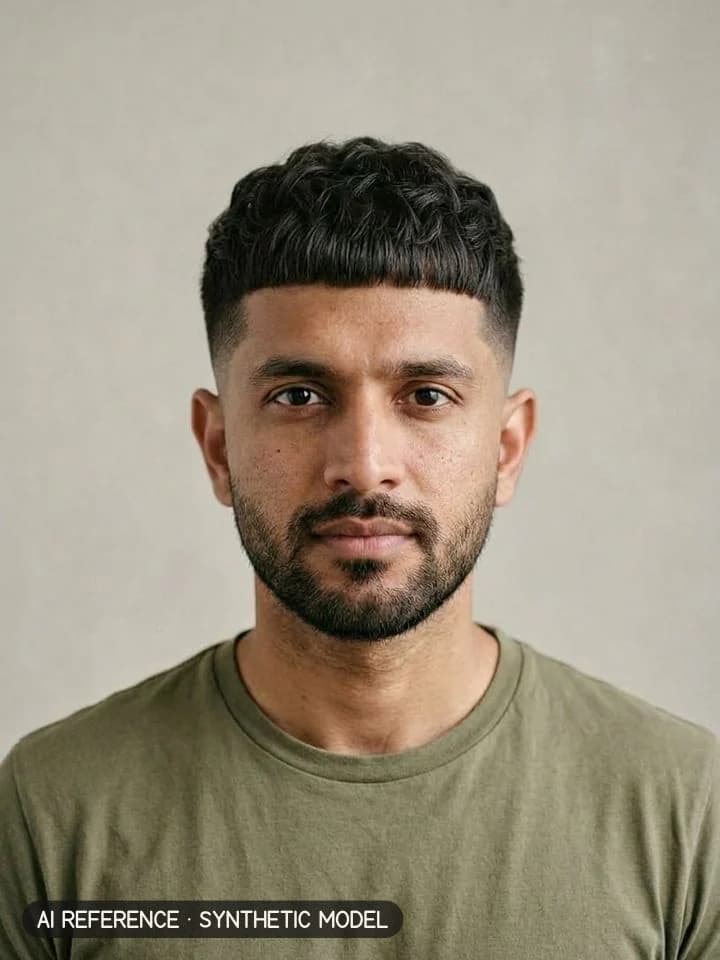
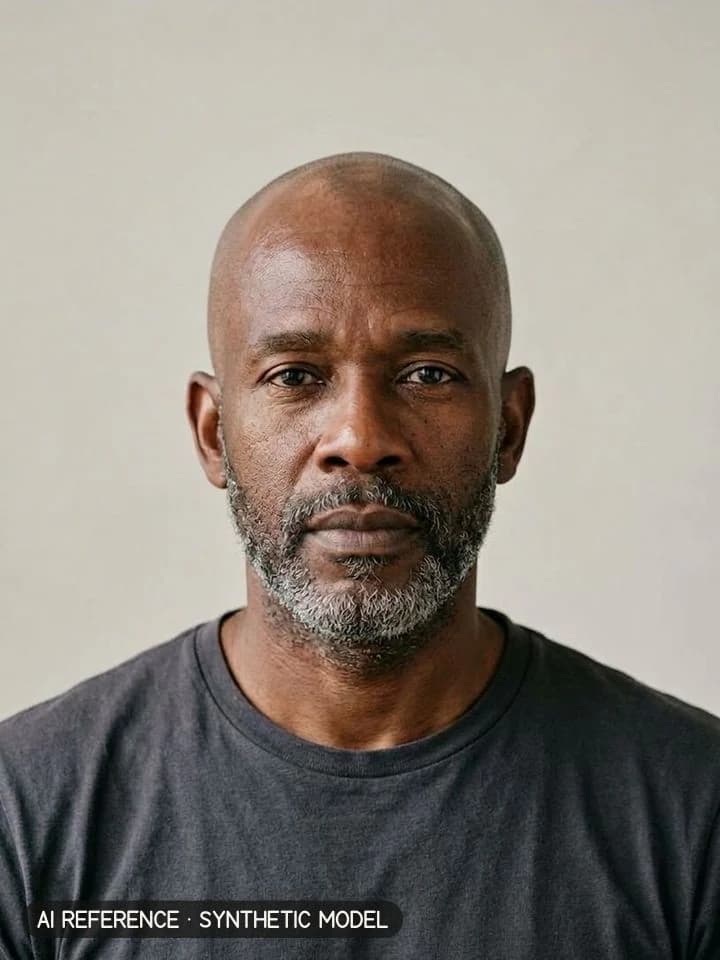
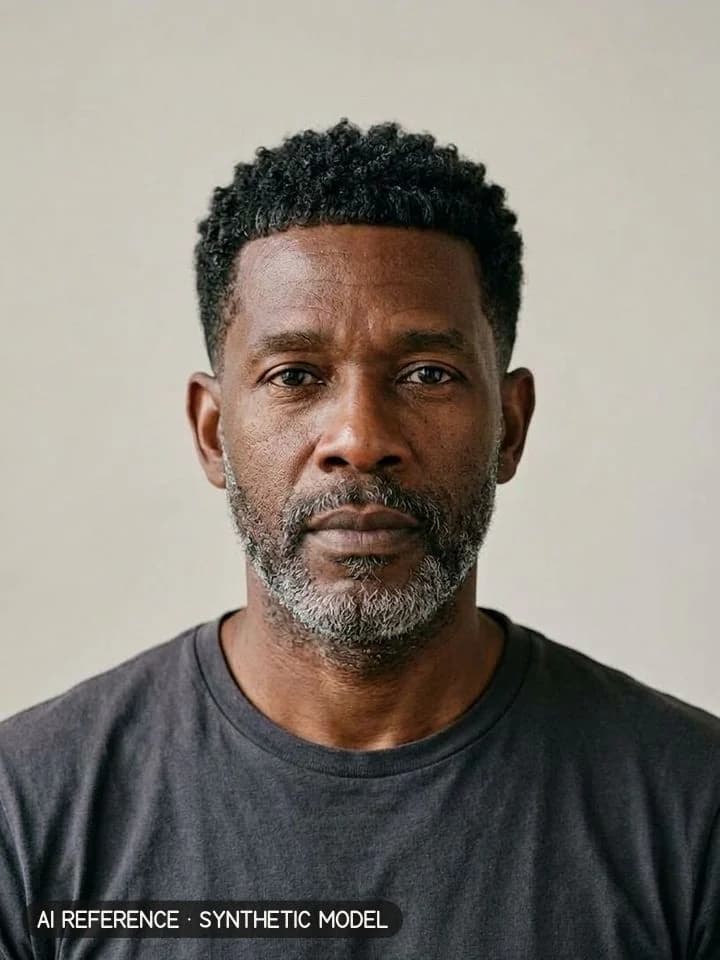
Shaved head / bald fade on Model M1 (light skin · straight 1B hair · 20s). AI reference on a synthetic model — not a real person.Shaved head / bald fade on Model M5 (light brown skin · curly 3B–3C hair · 20s). AI reference on a synthetic model — not a real person.Shaved head / bald fade on Model M6 (dark brown skin · coily 4A hair with some gray · 50s). AI reference on a synthetic model — not a real person.

AI references on synthetic models, not real people
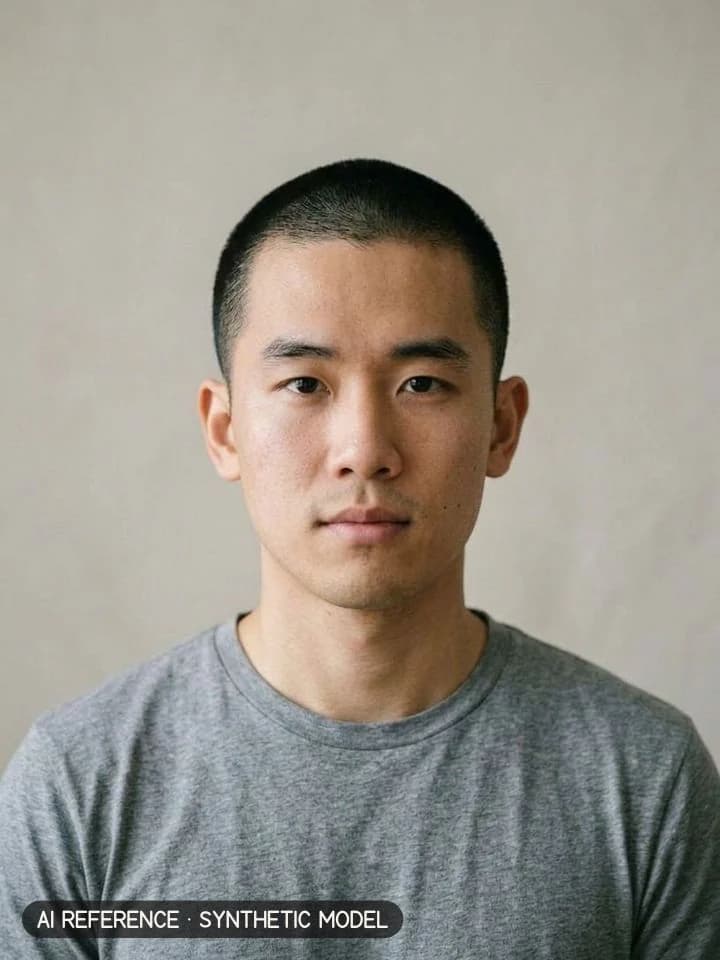
6. Modern mullet

55/100 proportion score

Best on 2A–3C · top 2–3 in (5–7.5 cm) · recut every 4–6 weeks

Why it ranks here

  • Puts weight at the jawline, which balances prominent cheekbones.Stylist convention

When it doesn’t work

  • A short, thick neck; conservative workplaces; trend-dependent (Janif 2014: rarer looks rate higher).
  • 1A, 1C, 4A–4C hair (straight and coily): the shape depends on a texture it can't hold, so we rule it out.
  • Low-density hair: the cut relies on bulk that thin hair doesn't have.

Tell your barber

“Taper or burst fade around the ears; textured top 2–3 in; leave 2–4 in at the nape, blended not shelved.”

Upkeep: trim every 4–6 weeks, about $270–$390 a year at $30 a cut.

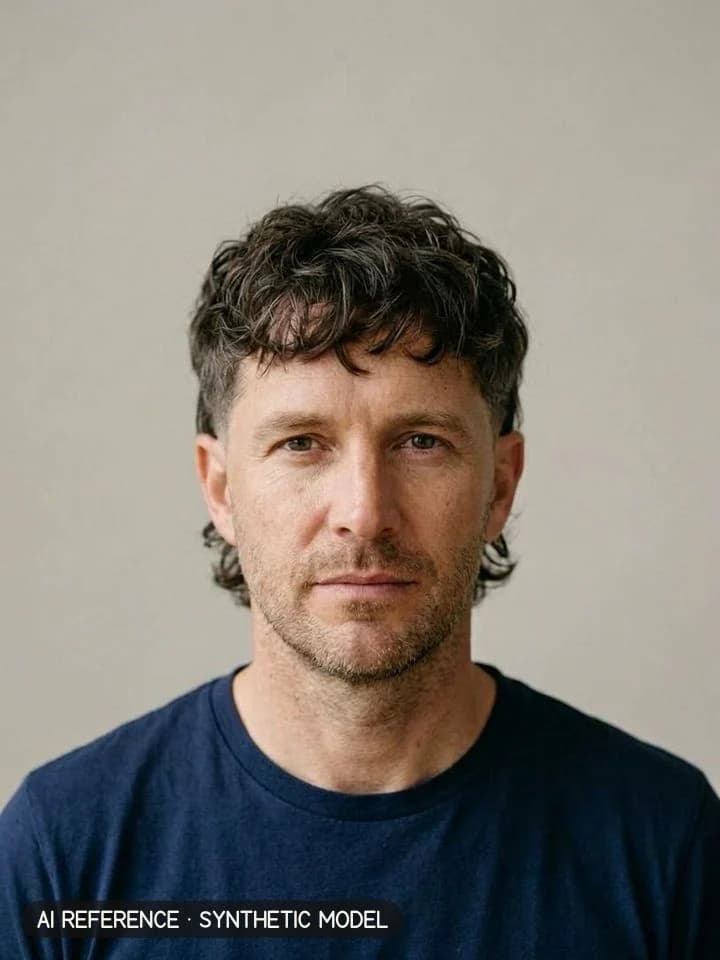
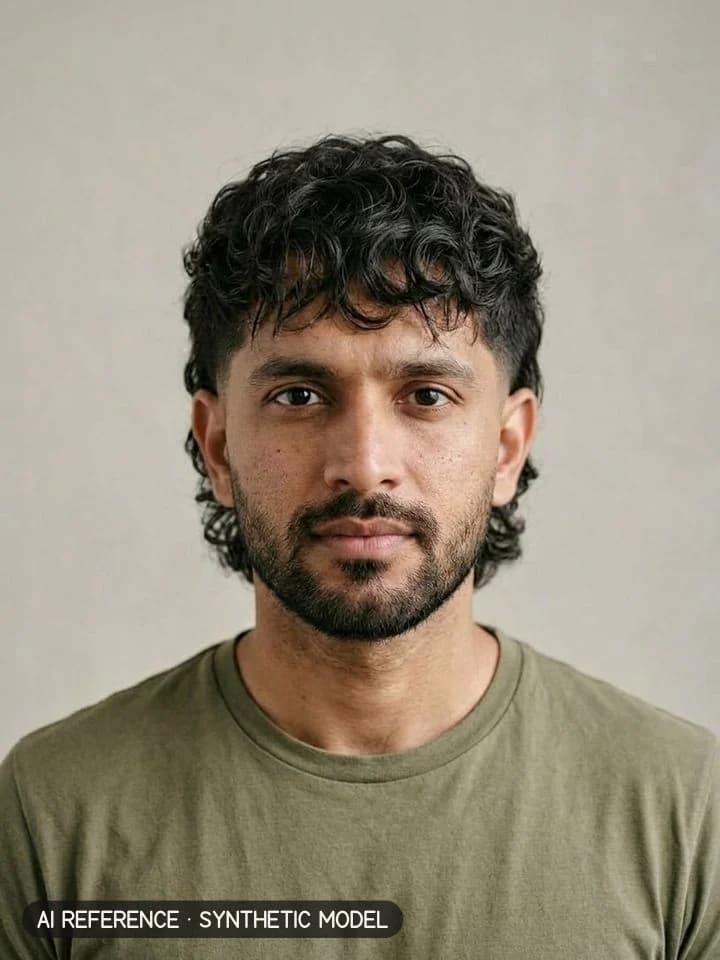
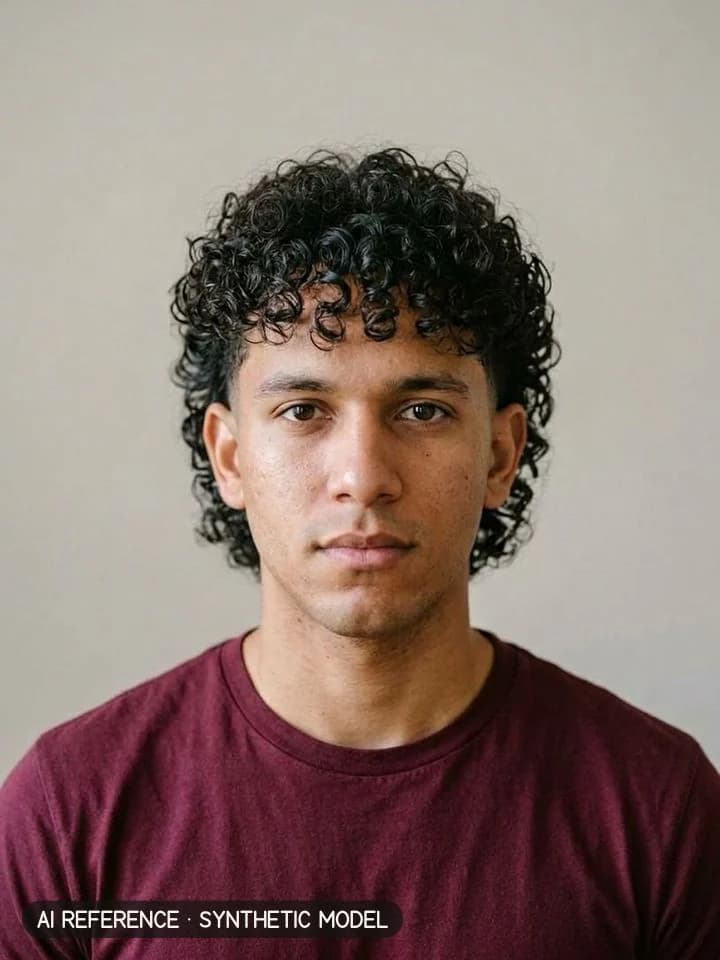
Modern mullet on Model M2 (fair skin · fine-wavy 2A hair with some gray · 40s). AI reference on a synthetic model — not a real person.Modern mullet on Model M3 (medium brown skin · thick wavy 2B–2C hair · 30s). AI reference on a synthetic model — not a real person.Modern mullet on Model M5 (light brown skin · curly 3B–3C hair · 20s). AI reference on a synthetic model — not a real person.

AI references on synthetic models, not real people

7. Caesar cut

55/100 proportion score

Best on 1A–4C · top 0.5–1 in (1.5–2.5 cm) · recut every 2–3 weeks

Why it ranks here

  • Adds straight lines and sharp edges, which balances a soft, rounded jaw.Stylist convention
  • Shortens the overall line, which balances a longer face.Stylist convention

When it doesn’t work

  • A very round face (add fade contrast).
  • A hairline past Norwood 4: at stage 5 it's shown with a caveat; beyond that we hide it.
  • Scores lower if you have a front cowlick.

Tell your barber

“Short horizontal fringe ~0.5–1 in; #1–3 sides; straight front line.”

  1. #13 mm
  2. #26 mm
  3. #310 mm

Upkeep: trim every 2–3 weeks, about $510–$780 a year at $30 a cut.

Caesar cut on Model M1 (light skin · straight 1B hair · 20s). AI reference on a synthetic model — not a real person.Caesar cut on Model M5 (light brown skin · curly 3B–3C hair · 20s). AI reference on a synthetic model — not a real person.Caesar cut on Model M6 (dark brown skin · coily 4A hair with some gray · 50s). AI reference on a synthetic model — not a real person.

AI references on synthetic models, not real people
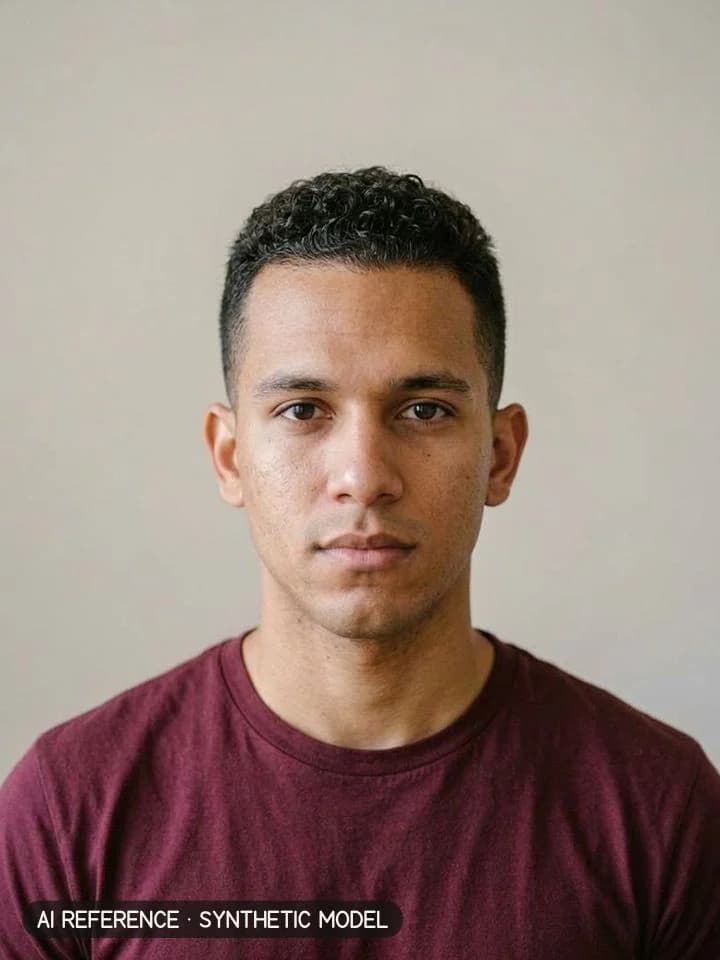
8. Classic taper (short back & sides)

54/100 proportion score

Best on 1A–3A · top 2–3 in (5–7.5 cm) · recut every 4–6 weeks

Why it ranks here

  • No proportion rule applies strongly here, so it ranks on how many hair types it works for.

When it doesn’t work

  • Few — it is the default for a reason.
  • 3B–4C hair (curly and coily): the shape depends on a texture it can't hold, so we rule it out.
  • A hairline past Norwood 3: at stage 4 it's shown with a caveat; beyond that we hide it.

Tell your barber

“Scissor-over-comb taper, not a skin fade; top 2–3 in side-swept; natural tapered neckline.”

  1. Skin0 mm
  2. #310 mm
  3. #413 mm

Upkeep: trim every 4–6 weeks, about $270–$390 a year at $30 a cut.

Classic taper (short back & sides) on Model M1 (light skin · straight 1B hair · 20s). AI reference on a synthetic model — not a real person.Classic taper (short back & sides) on Model M2 (fair skin · fine-wavy 2A hair with some gray · 40s). AI reference on a synthetic model — not a real person.Classic taper (short back & sides) on Model M3 (medium brown skin · thick wavy 2B–2C hair · 30s). AI reference on a synthetic model — not a real person.

AI references on synthetic models, not real people
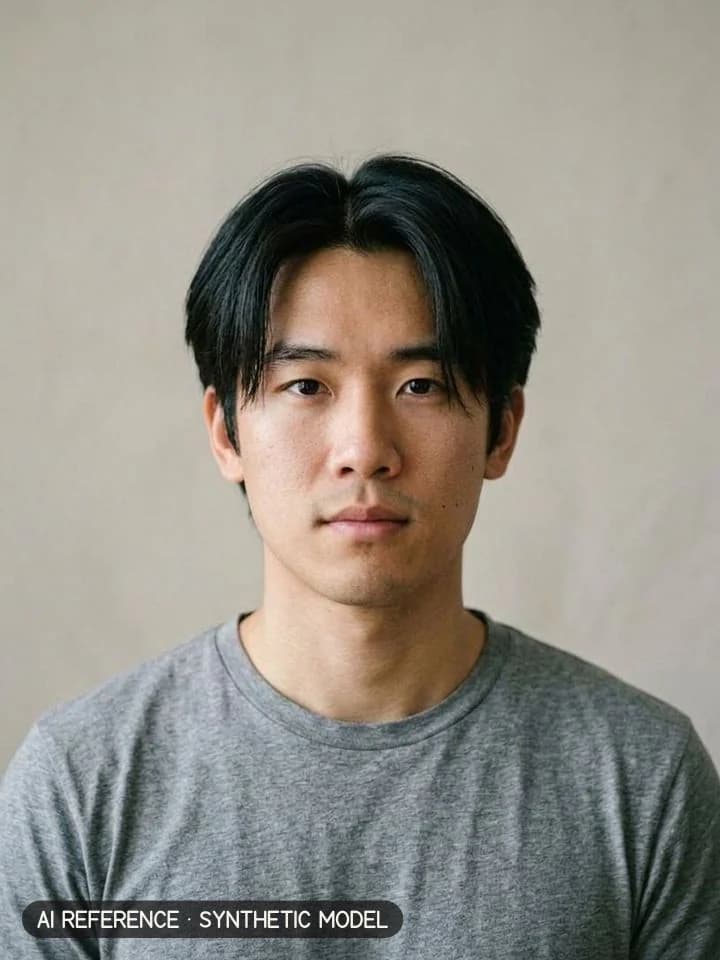
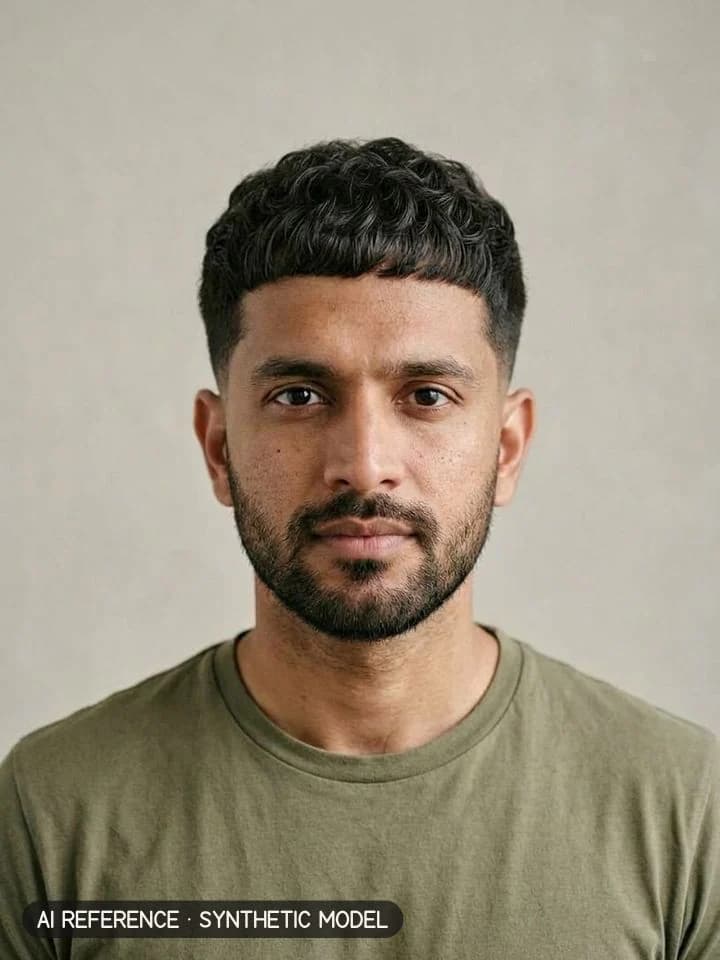
9. Textured crop

54/100 proportion score

Best on 1A–3B · top 1–2 in (2.5–5 cm) · recut every 3–4 weeks

Why it ranks here

  • Adds straight lines and sharp edges, which balances a soft, rounded jaw.Stylist convention

When it doesn’t work

  • A low forehead; a very round face if the top is left flat.
  • 4A–4C hair (coily): the shape depends on a texture it can't hold, so we rule it out.
  • A hairline past Norwood 3: at stage 4 it's shown with a caveat; beyond that we hide it.

Tell your barber

“Mid or high skin fade; top 1–2 in point-cut for texture; choppy fringe ~1 in above brows.”

  1. Skin0 mm
  2. #13 mm
  3. #26 mm

Upkeep: trim every 3–4 weeks, about $390–$510 a year at $30 a cut.

Textured crop on Model M1 (light skin · straight 1B hair · 20s). AI reference on a synthetic model — not a real person.Textured crop on Model M2 (fair skin · fine-wavy 2A hair with some gray · 40s). AI reference on a synthetic model — not a real person.Textured crop on Model M5 (light brown skin · curly 3B–3C hair · 20s). AI reference on a synthetic model — not a real person.

AI references on synthetic models, not real people

10. Side part / gentleman's cut

53/100 proportion score

Best on 1A–2B · top 2–4 in (5–10 cm) · recut every 4–5 weeks

Why it ranks here

  • No proportion rule applies strongly here, so it ranks on how many hair types it works for.

When it doesn’t work

  • The part must follow your whorl; from hairline stage 3 it is only possible with caveats.
  • 3B–4C hair (curly and coily): the shape depends on a texture it can't hold, so we rule it out.
  • Low-density hair: the cut relies on bulk that thin hair doesn't have.

Tell your barber

“Soft or hard part on my natural part; top 2–4 in; low taper; leave weight at the temples.”

Upkeep: trim every 4–5 weeks, about $300–$390 a year at $30 a cut.

Side part / gentleman's cut on Model M1 (light skin · straight 1B hair · 20s). AI reference on a synthetic model — not a real person.Side part / gentleman's cut on Model M2 (fair skin · fine-wavy 2A hair with some gray · 40s). AI reference on a synthetic model — not a real person.Side part / gentleman's cut on Model M3 (medium brown skin · thick wavy 2B–2C hair · 30s). AI reference on a synthetic model — not a real person.

AI references on synthetic models, not real people
What stylists aim for

Fill out the forehead and jaw, keep hair close at the cheekbones: fringes, some fullness at the temples, and weight near chin level.

Stylist convention

What convention says to skip

Tight sides at the cheekbones with nothing at the forehead or jaw, which puts all the width in one band.

Your list, not a textbook face. The free analysis adds your texture, density and hairline and explains every pick.

Start free · 2 min

Diamond face, men's cuts: questions

What is the best haircut for a diamond face (men)?
On proportions alone, our engine ranks the edgar cut, buzz cut and curtains / middle part highest for a textbook diamond face. For the edgar cut: keeps the cheek line slim, which balances prominent cheekbones. Your hair texture, density and hairline count for more than proportions, so your own list can differ.
What should men with diamond-shaped faces avoid?
By stylist convention: tight sides at the cheekbones with nothing at the forehead or jaw, which puts all the width in one band. It's a convention, not a law. A cut missing from this top 10 isn't wrong for a diamond face; it just does less for its proportions.
How do I know if my face is really diamond?
Most faces are a mix, and judging by eye is unreliable. The free face shape detector measures your length-to-width, forehead-to-jaw and jaw-corner ratios in your browser in about 10 seconds; your photo never leaves your phone. Even the textbook diamond face on this page reads as 76% diamond in our engine.
Why does my hair matter more than my face shape?
Because hair decides what a cut can physically do. Texture, density and hairline rule cuts in or out entirely; proportions only nudge the order, at about 15% of a full score. That's why this page is labelled proportions-only and the full analysis asks about your hair first.