Skip to content

Haircuts for a receding hairline, by Norwood stage

A receding hairline changes which cuts can work far more than face shape does. Our engine checks every men's cut against a Norwood stage: a cut stays on your list up to its limit, gets a “plan for the next stage” caveat one stage past it, and is hidden beyond that. Barber consensus

The advice barbers agree on: keep the top short or bring texture forward over the temples, and avoid styles that sweep hair back off them. Going very short, or shaving it, is a legitimate choice at any stage, not a last resort. Barber consensus

This page is about haircuts, not treatment. If your hairline is changing quickly, a dermatologist can tell you what is happening and what the options are.

Which men’s cuts still work, stage by stage

From the engine’s hair-loss gate. “Caveat” means one stage past the cut’s limit: still shown, with a note to plan for the next stage. Two or more stages past, it’s hidden.

Men’s cuts available at each Norwood stage
StageWorksWith a caveatHidden
Norwood 126Every men's cutNone0
Norwood 221Almost every men's cutSlick back, Pompadour, Curtains / middle part, Flow (medium swept back), High-top fade0
Norwood 312Buzz cut, Shaved head / bald fade, Crew cut, Textured crop, French crop, Caesar cut, Classic taper (short back & sides), High and tight, Faux hawk, Curly top + taper, Afro taper, 360 wavesIvy League, Side part / gentleman's cut, Quiff, Disconnected undercut, Two-block / K-style fringe, Modern mullet, Twists / starter locs, Long layered / man bun, Edgar cut5
Norwood 44Buzz cut, Shaved head / bald fade, Caesar cut, High and tightCrew cut, Textured crop, French crop, Classic taper (short back & sides), Faux hawk, Curly top + taper, Afro taper, 360 waves14
Norwood 52Buzz cut, Shaved head / bald fadeCaesar cut, High and tight22
Norwood 62Buzz cut, Shaved head / bald fadeNone24
Norwood 72Buzz cut, Shaved head / bald fadeNone24

Ranked by the engine · example profile 1

Men: straight 1B hair, medium density, Norwood 3, average proportions

A full engine run for this example profile, open to any length and style, so only the hair and the concern drive the order. Scores are the engine’s 0–100 fit for this profile, not a rating of anyone’s looks; confidence: high.

1. Crew cut

89/100 fit

Best on 1A–3B · top 1–1.5 in (2.5–4 cm) · recut every 3–4 weeks

Why it ranks here

  • Keeps the top short enough to suit a stage-3 hairline.Barber consensus
  • Suits 1B straight hair: the shape holds without fighting how your hair falls.Hair physics
  • Short on top, so a receding hairline blends in instead of standing out.Barber consensus

Needs a recut every 3–4 weeks to stay sharp (about $390/yr at $30 a cut).

When it doesn’t work

  • A very long face (the extra height lengthens it further).
  • 3C hair (curly): the shape depends on a texture it can't hold, so we rule it out.
  • A hairline past Norwood 3: at stage 4 it's shown with a caveat; beyond that we hide it.

Tell your barber

“#2–3 sides tapered; top 1–1.5 in at front graduating shorter to crown.”

  1. #26 mm
  2. #310 mm

Upkeep: trim every 3–4 weeks, about $390–$510 a year at $30 a cut.

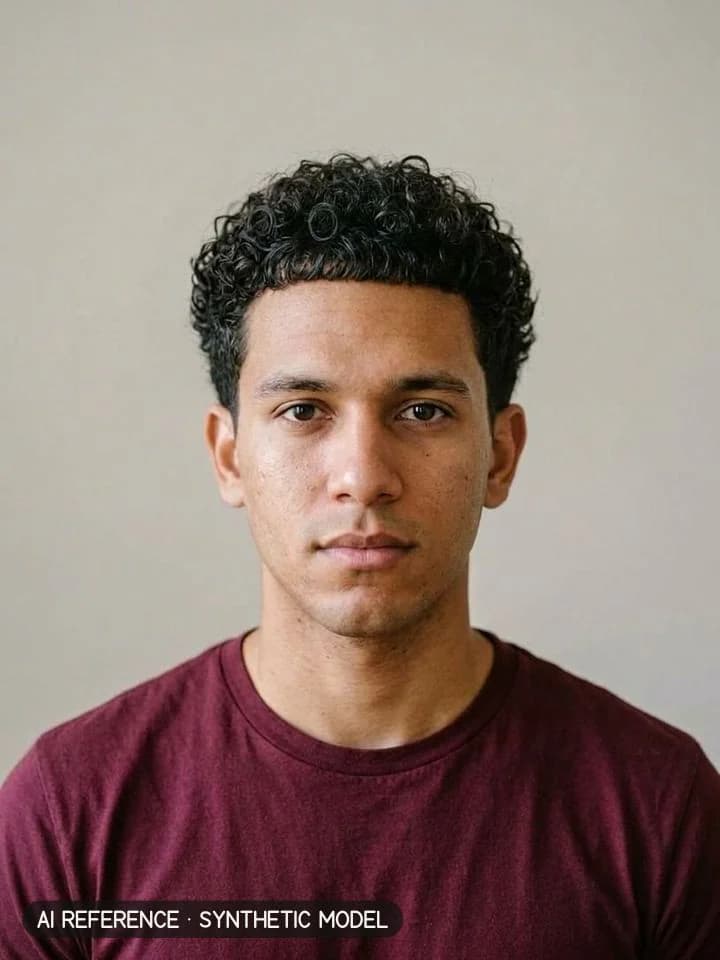
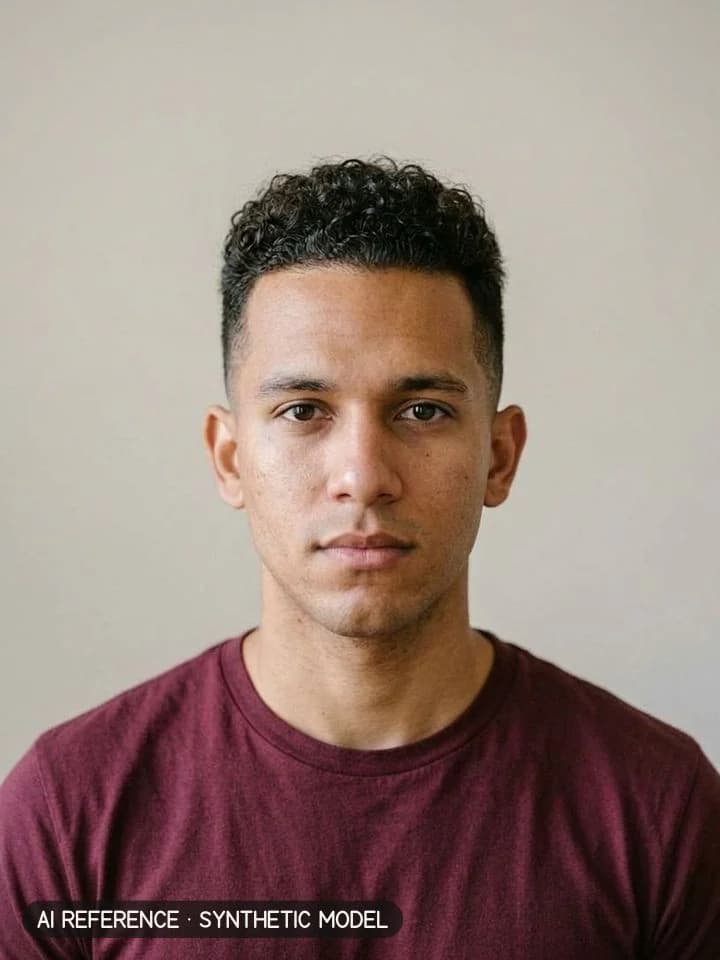
Crew cut on Model M2 (fair skin · fine-wavy 2A hair with some gray · 40s). AI reference on a synthetic model — not a real person.Crew cut on Model M4 (deep brown skin · coily 4C hair · 30s). AI reference on a synthetic model — not a real person.Crew cut on Model M5 (light brown skin · curly 3B–3C hair · 20s). AI reference on a synthetic model — not a real person.

AI references on synthetic models, not real people

2. Textured crop

89/100 fit

Best on 1A–3B · top 1–2 in (2.5–5 cm) · recut every 3–4 weeks

Why it ranks here

  • Brings hair forward over the temples, which softens stage-3 recession.Barber consensus
  • Suits 1B straight hair: the shape holds without fighting how your hair falls.Hair physics
  • Forward texture covers temple recession.Barber consensus

Needs a recut every 3–4 weeks to stay sharp (about $390/yr at $30 a cut). Keep the top at the short end (about 1.5 in) for a stage-3 hairline

When it doesn’t work

  • A low forehead; a very round face if the top is left flat.
  • 4A–4C hair (coily): the shape depends on a texture it can't hold, so we rule it out.
  • A hairline past Norwood 3: at stage 4 it's shown with a caveat; beyond that we hide it.

Tell your barber

“Mid or high skin fade; top 1–2 in point-cut for texture; choppy fringe ~1 in above brows.”

  1. Skin0 mm
  2. #13 mm
  3. #26 mm

Upkeep: trim every 3–4 weeks, about $390–$510 a year at $30 a cut.

Textured crop on Model M1 (light skin · straight 1B hair · 20s). AI reference on a synthetic model — not a real person.Textured crop on Model M2 (fair skin · fine-wavy 2A hair with some gray · 40s). AI reference on a synthetic model — not a real person.Textured crop on Model M5 (light brown skin · curly 3B–3C hair · 20s). AI reference on a synthetic model — not a real person.

AI references on synthetic models, not real people

3. French crop

89/100 fit

Best on 1A–2C · top 1–2 in (2.5–5 cm) · recut every 3–4 weeks

Why it ranks here

  • Brings hair forward over the temples, which softens stage-3 recession.Barber consensus
  • Suits 1B straight hair: the shape holds without fighting how your hair falls.Hair physics
  • Forward texture covers temple recession.Barber consensus

Needs a recut every 3–4 weeks to stay sharp (about $390/yr at $30 a cut). Keep the top at the short end (about 1.5 in) for a stage-3 hairline

When it doesn’t work

  • A low forehead, a front cowlick, a round face without fade contrast.
  • 3B–4C hair (curly and coily): the shape depends on a texture it can't hold, so we rule it out.
  • A hairline past Norwood 3: at stage 4 it's shown with a caveat; beyond that we hide it.

Tell your barber

“Blunt straight fringe at mid-forehead; top 1–2 in; low or mid taper sides.”

Upkeep: trim every 3–4 weeks, about $390–$510 a year at $30 a cut.
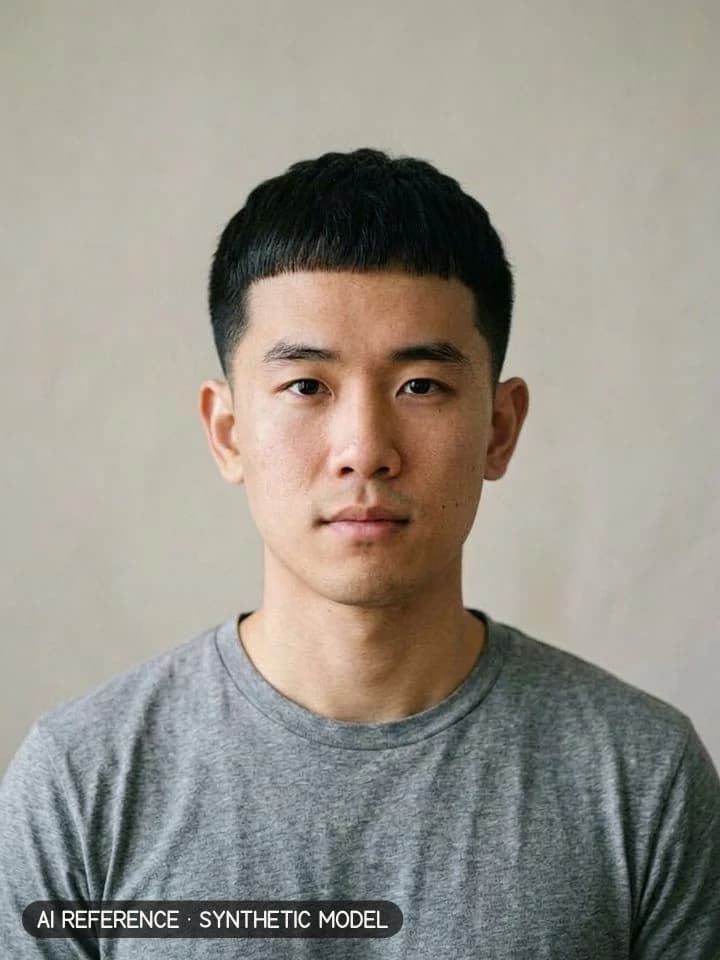
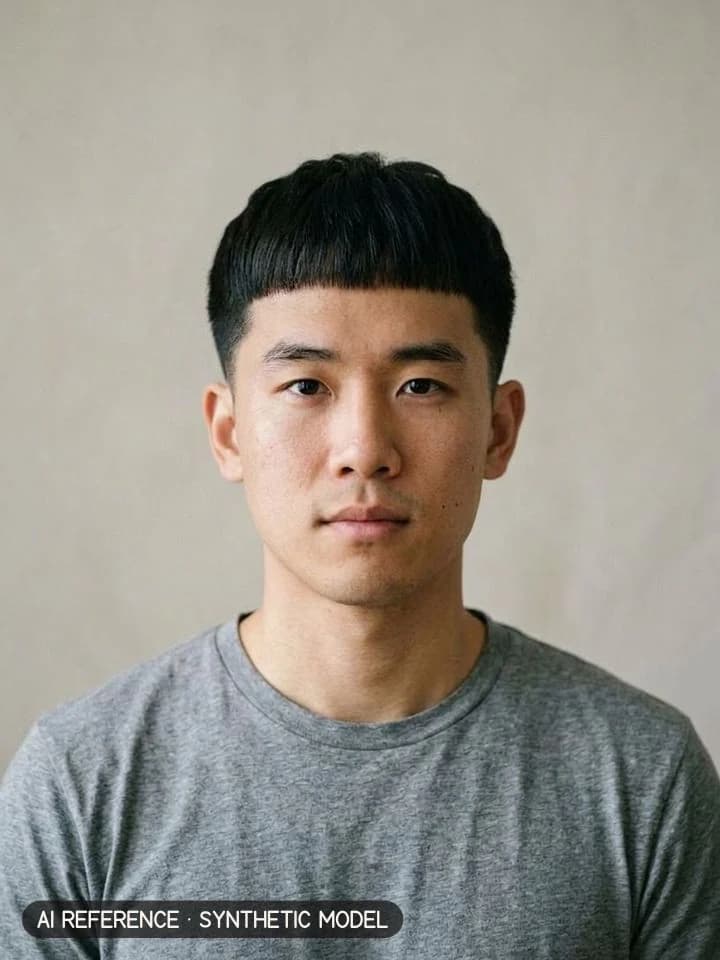
French crop on Model M1 (light skin · straight 1B hair · 20s). AI reference on a synthetic model — not a real person.French crop on Model M2 (fair skin · fine-wavy 2A hair with some gray · 40s). AI reference on a synthetic model — not a real person.French crop on Model M3 (medium brown skin · thick wavy 2B–2C hair · 30s). AI reference on a synthetic model — not a real person.

AI references on synthetic models, not real people
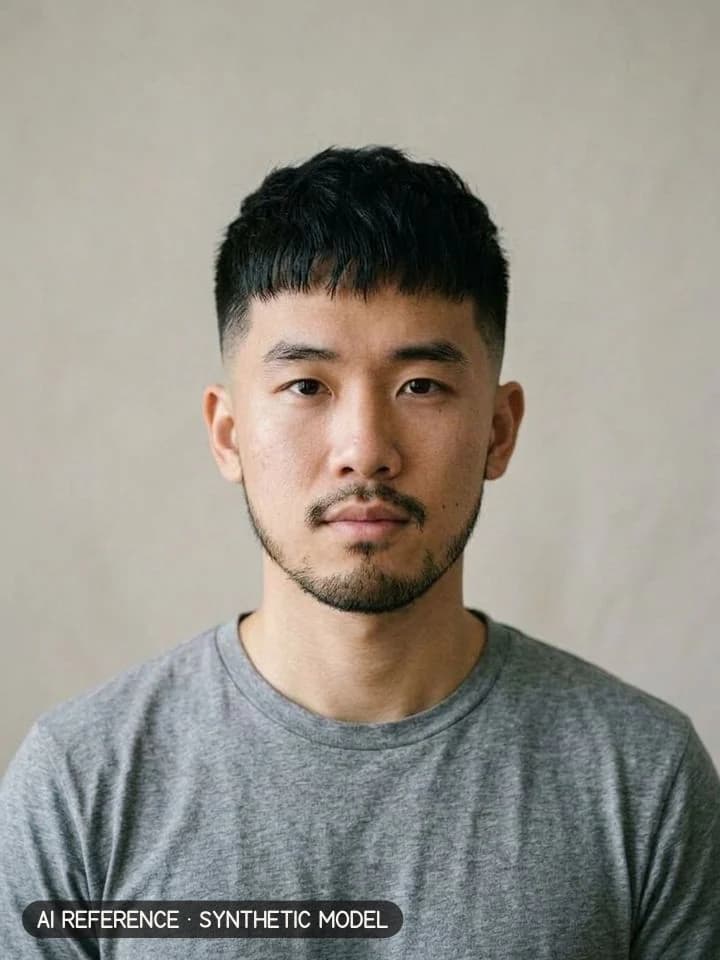
4. Buzz cut

87/100 fit

Best on 1A–4C · top 0.3–0.4 in (0.5–1 cm) · recut every 2–3 weeks

Why it ranks here

  • Keeps the top short enough to suit a stage-3 hairline.Barber consensus
  • Suits 1B straight hair: the shape holds without fighting how your hair falls.Hair physics
  • Short on top, so a receding hairline blends in instead of standing out.Barber consensus

When it doesn’t work

  • Puts bumps, a flat back of the head and prominent ears on show.
  • Scores lower if you have prominent ears.

Tell your barber

“#2 (6 mm) all over, or #3 top / #1 sides blended; tapered neckline; edge up.”

  1. #13 mm
  2. #26 mm
  3. #310 mm

Upkeep: trim every 2–3 weeks, about $510–$780 a year at $30 a cut.

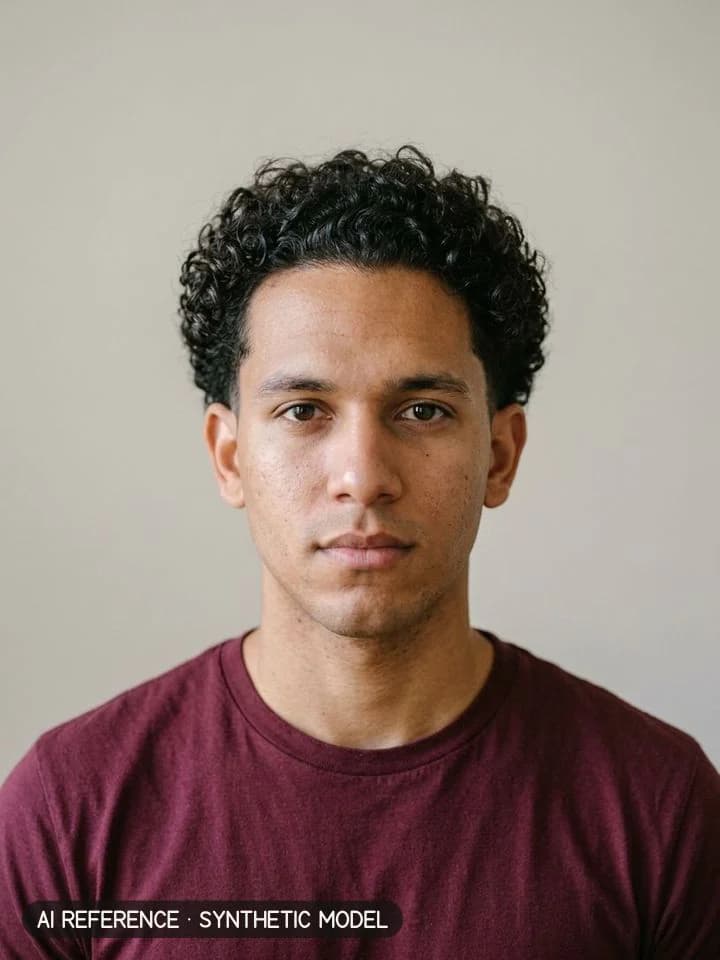
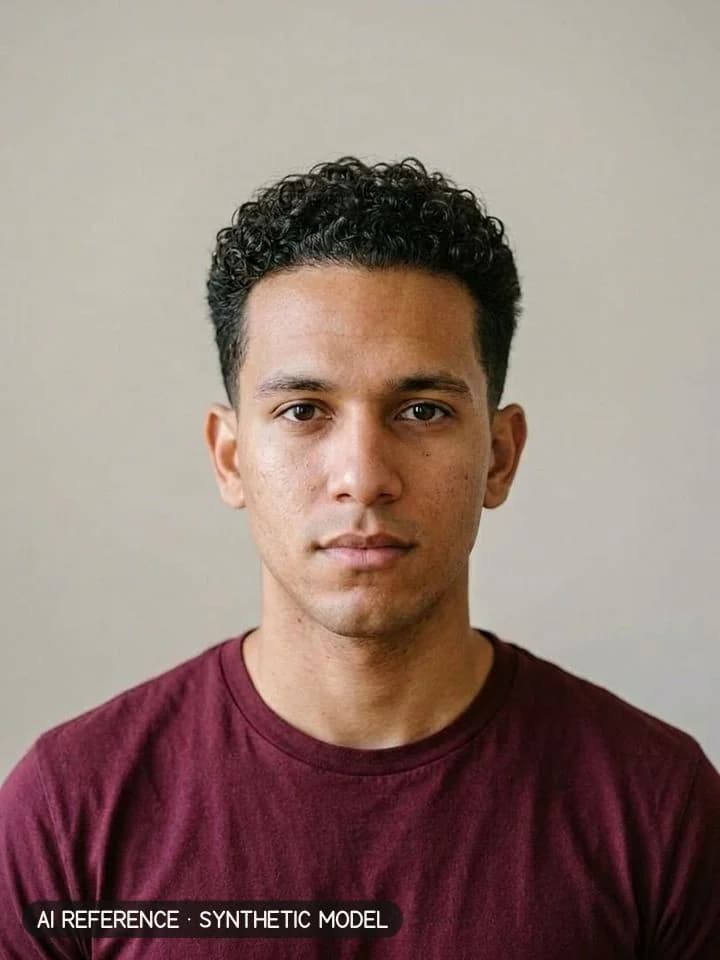
Buzz cut on Model M1 (light skin · straight 1B hair · 20s). AI reference on a synthetic model — not a real person.Buzz cut on Model M4 (deep brown skin · coily 4C hair · 30s). AI reference on a synthetic model — not a real person.Buzz cut on Model M5 (light brown skin · curly 3B–3C hair · 20s). AI reference on a synthetic model — not a real person.

AI references on synthetic models, not real people

Best on 1A–4C · top 0–0.1 in (0 cm) · recut every 2–3 weeks

Why it ranks here

  • Keeps the top short enough to suit a stage-3 hairline.Barber consensus
  • Suits 1B straight hair: the shape holds without fighting how your hair falls.Hair physics
  • In a study of first impressions, a clean-shaven head read as more dominant than visible thinning.Study

When it doesn’t work

  • Shows an irregular skull shape or scars. Trade-off from a US study (Mannes 2013): a shaved head reads as more dominant and about 4 years older, and scored lower on looks than a full head of hair.
  • Scores lower if you have prominent ears.

Tell your barber

“Bald fade from 0 on sides; top foil or #0.5; blend into beard.”

  1. Skin0 mm
  2. #0.51.5 mm

Upkeep: trim every 2–3 weeks, about $510–$780 a year at $30 a cut.

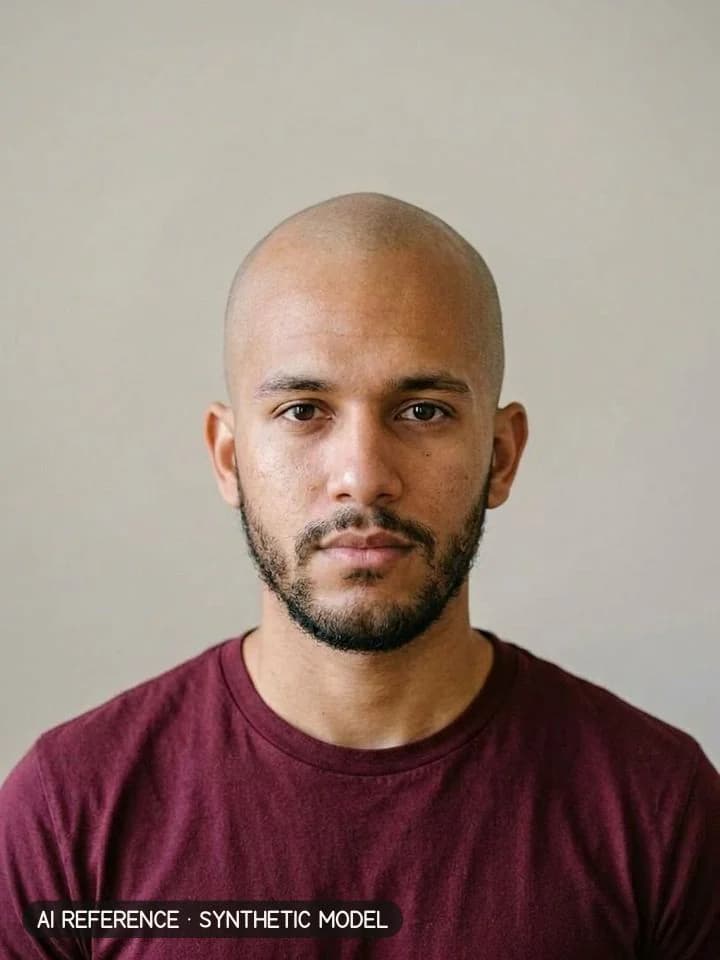
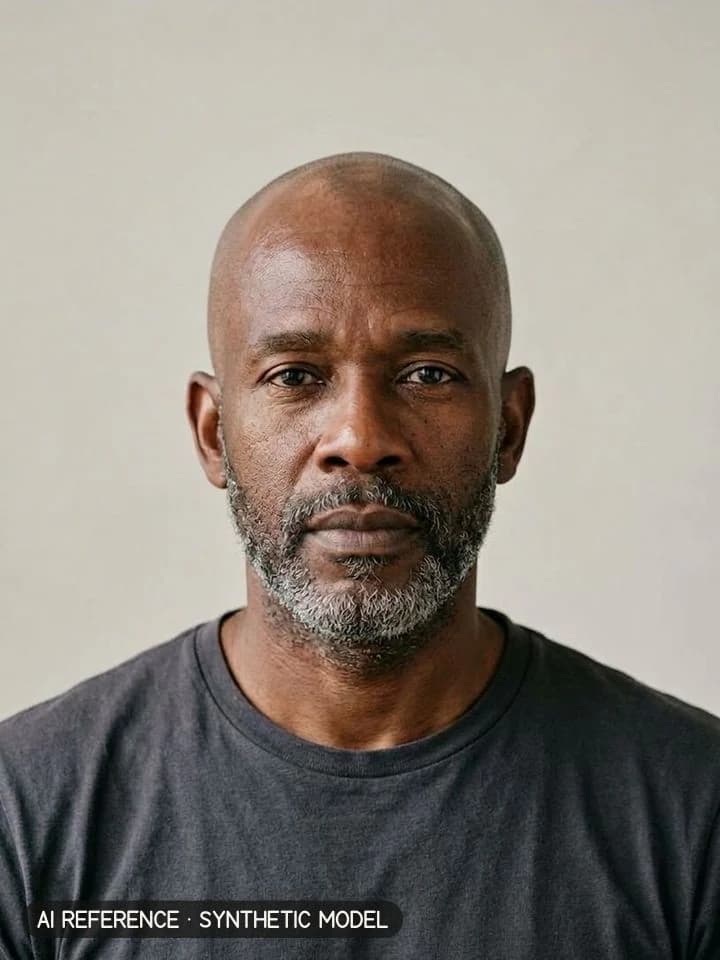
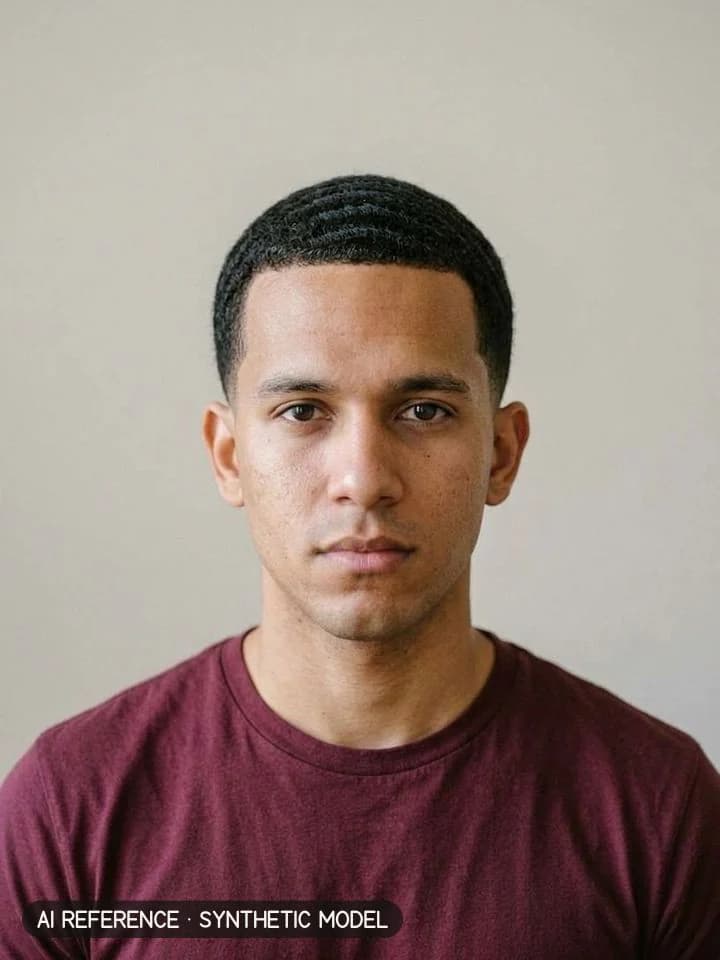
Shaved head / bald fade on Model M1 (light skin · straight 1B hair · 20s). AI reference on a synthetic model — not a real person.Shaved head / bald fade on Model M5 (light brown skin · curly 3B–3C hair · 20s). AI reference on a synthetic model — not a real person.Shaved head / bald fade on Model M6 (dark brown skin · coily 4A hair with some gray · 50s). AI reference on a synthetic model — not a real person.

AI references on synthetic models, not real people
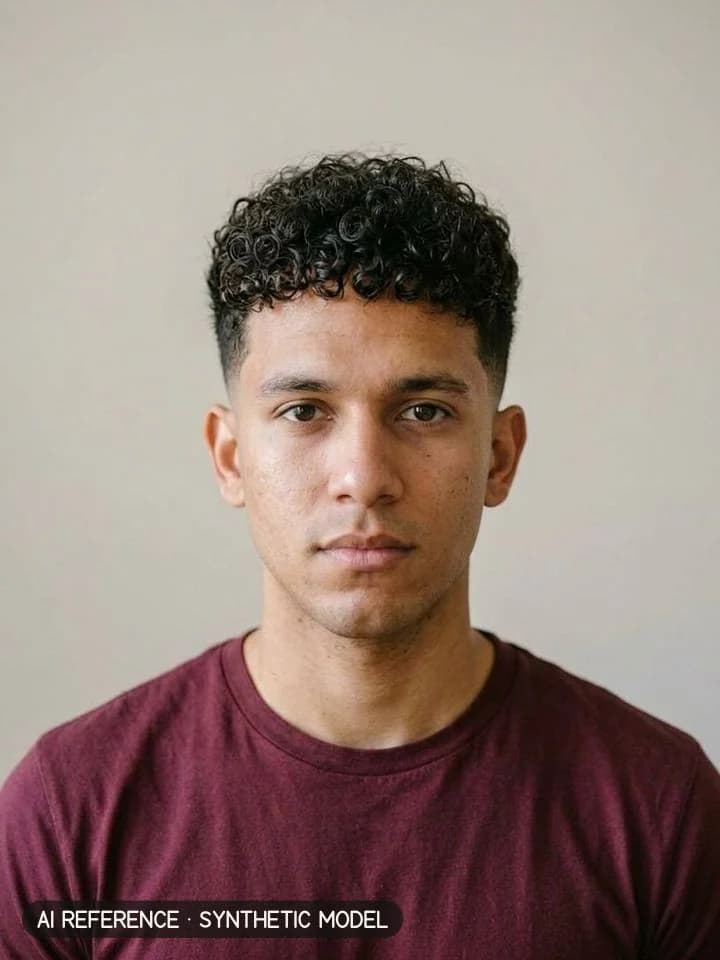
6. Caesar cut

87/100 fit

Best on 1A–4C · top 0.5–1 in (1.5–2.5 cm) · recut every 2–3 weeks

Why it ranks here

  • Brings hair forward over the temples, which softens stage-3 recession.Barber consensus
  • Suits 1B straight hair: the shape holds without fighting how your hair falls.Hair physics
  • Forward texture covers temple recession.Barber consensus

When it doesn’t work

  • A very round face (add fade contrast).
  • A hairline past Norwood 4: at stage 5 it's shown with a caveat; beyond that we hide it.
  • Scores lower if you have a front cowlick.

Tell your barber

“Short horizontal fringe ~0.5–1 in; #1–3 sides; straight front line.”

  1. #13 mm
  2. #26 mm
  3. #310 mm

Upkeep: trim every 2–3 weeks, about $510–$780 a year at $30 a cut.

Caesar cut on Model M1 (light skin · straight 1B hair · 20s). AI reference on a synthetic model — not a real person.Caesar cut on Model M5 (light brown skin · curly 3B–3C hair · 20s). AI reference on a synthetic model — not a real person.Caesar cut on Model M6 (dark brown skin · coily 4A hair with some gray · 50s). AI reference on a synthetic model — not a real person.

AI references on synthetic models, not real people
Popular cuts this profile should skip

  • Edgar cut: ranks low for this profile: possible now, but at hairline stage 3 this cut is past its comfort zone (it suits up to stage 2) — plan for the next stage.
  • Curtains / middle part: keeps at least 4 in on top, which shows thinning at hairline stage 3 (it suits up to stage 1).
  • Slick back: sweeps hair back and needs a full front hairline (it suits up to stage 1); at stage 3 it puts the temples on show.

Ranked by the engine · example profile 2

Men: coily 4C hair, medium density, Norwood 4, average proportions

A full engine run for this example profile, open to any length and style, so only the hair and the concern drive the order. Scores are the engine’s 0–100 fit for this profile, not a rating of anyone’s looks; confidence: high.

1. Buzz cut

87/100 fit

Best on 1A–4C · top 0.3–0.4 in (0.5–1 cm) · recut every 2–3 weeks

Why it ranks here

  • Keeps the top short enough to suit a stage-4 hairline.Barber consensus
  • Made for 4C coils: the shape holds and allows for natural shrinkage.Hair physics
  • Short on top, so a receding hairline blends in instead of standing out.Barber consensus

When it doesn’t work

  • Puts bumps, a flat back of the head and prominent ears on show.
  • Scores lower if you have prominent ears.

Tell your barber

“#2 (6 mm) all over, or #3 top / #1 sides blended; tapered neckline; edge up.”

  1. #13 mm
  2. #26 mm
  3. #310 mm

Upkeep: trim every 2–3 weeks, about $510–$780 a year at $30 a cut.

Buzz cut on Model M1 (light skin · straight 1B hair · 20s). AI reference on a synthetic model — not a real person.Buzz cut on Model M4 (deep brown skin · coily 4C hair · 30s). AI reference on a synthetic model — not a real person.Buzz cut on Model M5 (light brown skin · curly 3B–3C hair · 20s). AI reference on a synthetic model — not a real person.

AI references on synthetic models, not real people

Best on 1A–4C · top 0–0.1 in (0 cm) · recut every 2–3 weeks

Why it ranks here

  • Keeps the top short enough to suit a stage-4 hairline.Barber consensus
  • Made for 4C coils: the shape holds and allows for natural shrinkage.Hair physics
  • In a study of first impressions, a clean-shaven head read as more dominant than visible thinning.Study

When it doesn’t work

  • Shows an irregular skull shape or scars. Trade-off from a US study (Mannes 2013): a shaved head reads as more dominant and about 4 years older, and scored lower on looks than a full head of hair.
  • Scores lower if you have prominent ears.

Tell your barber

“Bald fade from 0 on sides; top foil or #0.5; blend into beard.”

  1. Skin0 mm
  2. #0.51.5 mm

Upkeep: trim every 2–3 weeks, about $510–$780 a year at $30 a cut.

Shaved head / bald fade on Model M1 (light skin · straight 1B hair · 20s). AI reference on a synthetic model — not a real person.Shaved head / bald fade on Model M5 (light brown skin · curly 3B–3C hair · 20s). AI reference on a synthetic model — not a real person.Shaved head / bald fade on Model M6 (dark brown skin · coily 4A hair with some gray · 50s). AI reference on a synthetic model — not a real person.

AI references on synthetic models, not real people
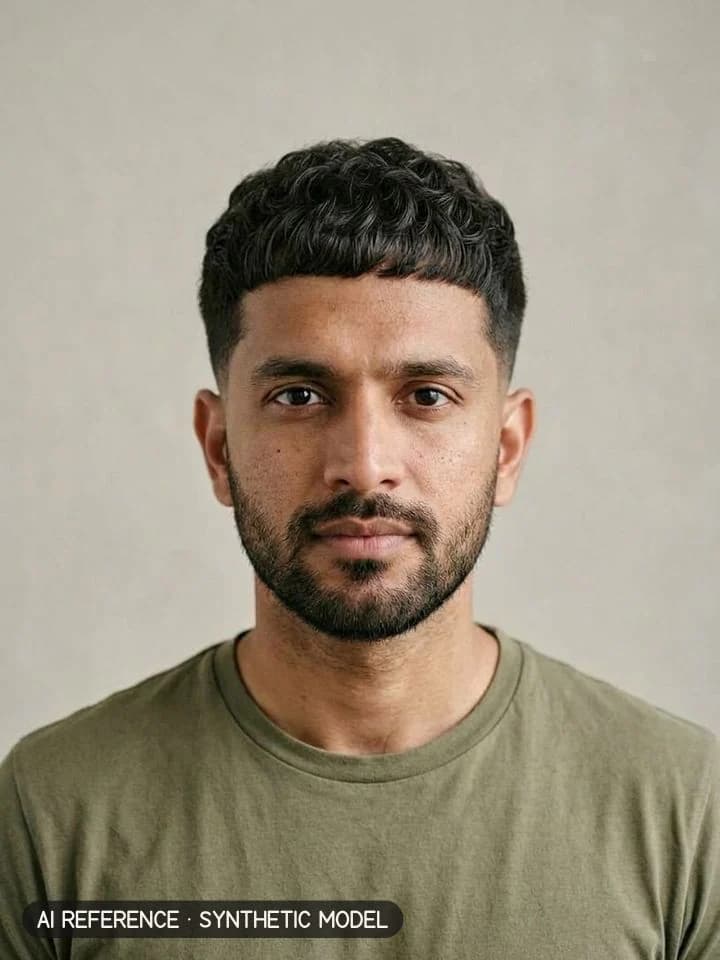
3. Caesar cut

85/100 fit

Best on 1A–4C · top 0.5–1 in (1.5–2.5 cm) · recut every 2–3 weeks

Why it ranks here

  • Brings hair forward over the temples, which softens stage-4 recession.Barber consensus
  • Made for 4C coils: the shape holds and allows for natural shrinkage.Hair physics
  • Forward texture covers temple recession.Barber consensus

When it doesn’t work

  • A very round face (add fade contrast).
  • A hairline past Norwood 4: at stage 5 it's shown with a caveat; beyond that we hide it.
  • Scores lower if you have a front cowlick.

Tell your barber

“Short horizontal fringe ~0.5–1 in; #1–3 sides; straight front line.”

  1. #13 mm
  2. #26 mm
  3. #310 mm

Upkeep: trim every 2–3 weeks, about $510–$780 a year at $30 a cut.

Caesar cut on Model M1 (light skin · straight 1B hair · 20s). AI reference on a synthetic model — not a real person.Caesar cut on Model M5 (light brown skin · curly 3B–3C hair · 20s). AI reference on a synthetic model — not a real person.Caesar cut on Model M6 (dark brown skin · coily 4A hair with some gray · 50s). AI reference on a synthetic model — not a real person.

AI references on synthetic models, not real people
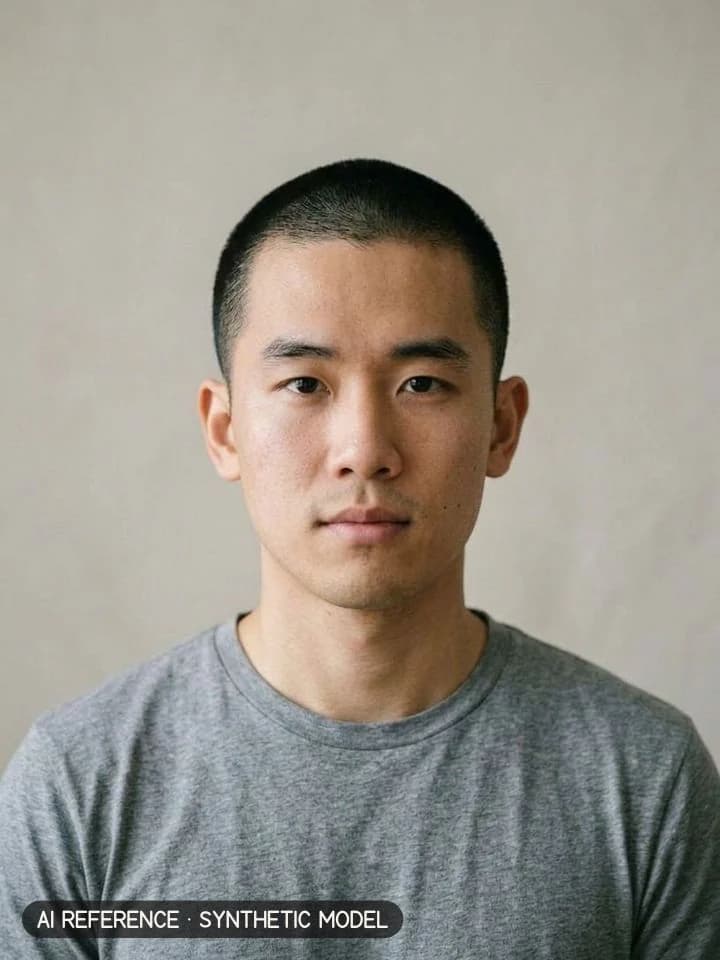
4. High and tight

81/100 fit

Best on 1A–4C · top 0.5–1 in (1.5–2.5 cm) · recut every 2 weeks

Why it ranks here

  • Keeps the top short enough to suit a stage-4 hairline.Barber consensus
  • Made for 4C coils: the shape holds and allows for natural shrinkage.Hair physics
  • Short on top, so a receding hairline blends in instead of standing out.Barber consensus

When it doesn’t work

  • A long, narrow face; prominent ears; bumps on the sides of the head.
  • A hairline past Norwood 4: at stage 5 it's shown with a caveat; beyond that we hide it.
  • Scores lower if you have prominent ears.

Tell your barber

“#0.5–1 sides up to the parietal ridge; top 0.5–1 in; hard transition.”

  1. #0.51.5 mm
  2. #13 mm

Upkeep: trim every 2 weeks, about $780–$780 a year at $30 a cut.

High and tight on Model M2 (fair skin · fine-wavy 2A hair with some gray · 40s). AI reference on a synthetic model — not a real person.High and tight on Model M4 (deep brown skin · coily 4C hair · 30s). AI reference on a synthetic model — not a real person.High and tight on Model M5 (light brown skin · curly 3B–3C hair · 20s). AI reference on a synthetic model — not a real person.

AI references on synthetic models, not real people

5. 360 waves

43/100 fit

Best on 3C–4C · top 0.1–0.3 in (0.5 cm) · recut every 2–3 weeks

Why it ranks here

  • Made for 4C coils: the shape holds and allows for natural shrinkage.Hair physics
  • Short on top, so a receding hairline blends in instead of standing out.Barber consensus

Possible now, but at hairline stage 4 this cut is past its comfort zone (it suits up to stage 3) — plan for the next stage.

When it doesn’t work

  • Needs daily brushing and a durag.
  • 1A–3B hair (straight, wavy and curly): the shape depends on a texture it can't hold, so we rule it out.
  • A hairline past Norwood 3: at stage 4 it's shown with a caveat; beyond that we hide it.

Tell your barber

“Top #1–2 with the grain; low taper; crisp line-up.”

  1. #13 mm
  2. #26 mm

Upkeep: trim every 2–3 weeks, about $510–$780 a year at $30 a cut.

360 waves on Model M4 (deep brown skin · coily 4C hair · 30s). AI reference on a synthetic model — not a real person.360 waves on Model M5 (light brown skin · curly 3B–3C hair · 20s). AI reference on a synthetic model — not a real person.360 waves on Model M6 (dark brown skin · coily 4A hair with some gray · 50s). AI reference on a synthetic model — not a real person.

AI references on synthetic models, not real people
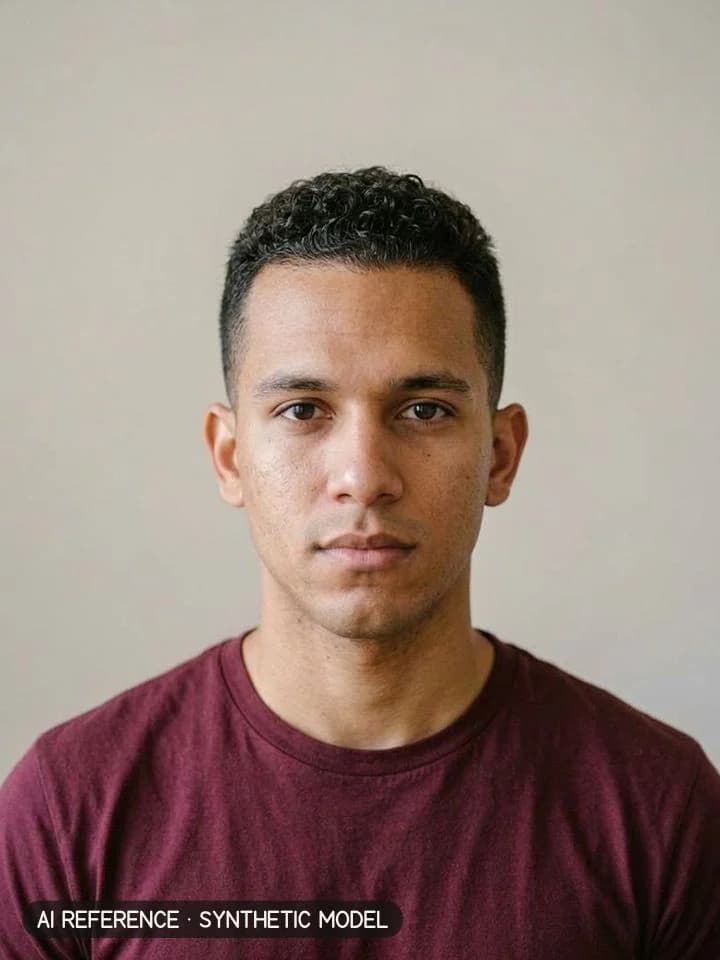
6. Afro taper

42/100 fit

Best on 4A–4C · top 2–5 in (5–12.5 cm) · recut every 2–4 weeks

Why it ranks here

  • Made for 4C coils: the shape holds and allows for natural shrinkage.Hair physics

Possible now, but at hairline stage 4 this cut is past its comfort zone (it suits up to stage 3) — plan for the next stage.

When it doesn’t work

  • Few; needs regular moisture.
  • 1A–3B hair (straight, wavy and curly): the shape depends on a texture it can't hold, so we rule it out.
  • A hairline past Norwood 3: at stage 4 it's shown with a caveat; beyond that we hide it.

Tell your barber

“Temple and nape taper (burst optional); shape the top 2–5 in rounded; sponge or pick.”

Upkeep: trim every 2–4 weeks, about $390–$780 a year at $30 a cut.

Afro taper on Model M4 (deep brown skin · coily 4C hair · 30s). AI reference on a synthetic model — not a real person.Afro taper on Model M5 (light brown skin · curly 3B–3C hair · 20s). AI reference on a synthetic model — not a real person.Afro taper on Model M6 (dark brown skin · coily 4A hair with some gray · 50s). AI reference on a synthetic model — not a real person.

AI references on synthetic models, not real people
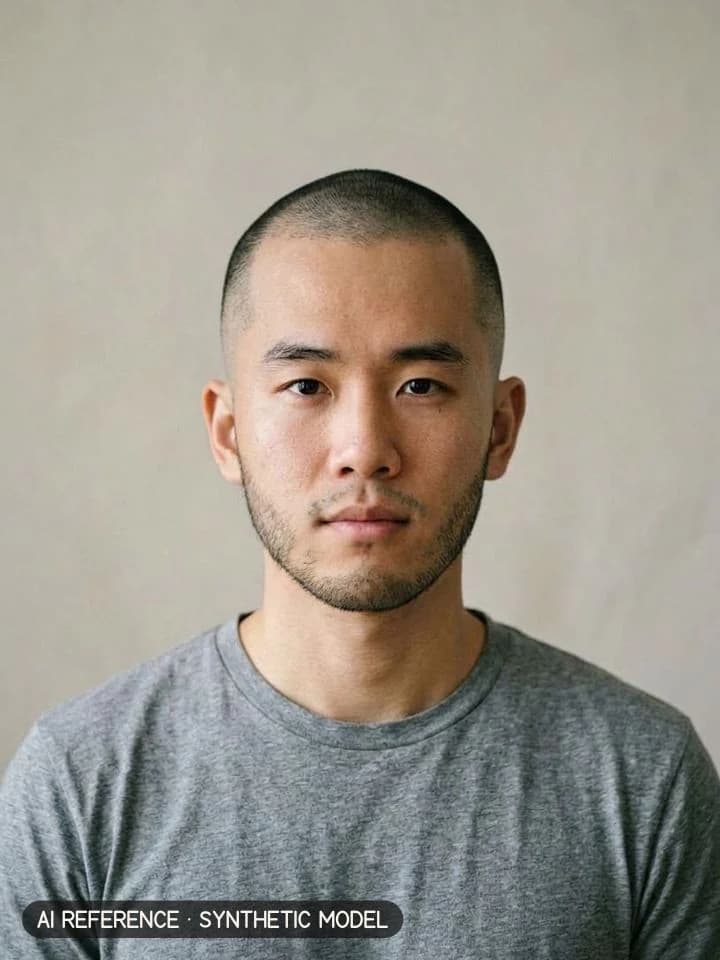
Popular cuts this profile should skip

  • Edgar cut: depends on hair that lies flat or blow-dries smooth (1A–3A); 4C hair curls up and shrinks out of that shape. Closer fit: High and tight.
  • Classic taper (short back & sides): depends on hair that lies flat or blow-dries smooth (1A–3A); 4C hair curls up and shrinks out of that shape. Closer fit: Caesar cut.
  • Textured crop: depends on hair that lies flat or blow-dries smooth (1A–3C); 4C hair curls up and shrinks out of that shape.

Every cut the engine moves up or down

These are the catalog’s own feature rules, the same ones your analysis applies. Each nudges a cut’s score by a small, fixed amount; texture, density and hairline still decide more.

With a receding hairline (Norwood 2 or more)

Scores higher (9)

  • 360 wavesBarber consensus

    Short on top, so a receding hairline blends in instead of standing out.

  • Forward texture covers temple recession.

  • Buzz cutBarber consensus

    Short on top, so a receding hairline blends in instead of standing out.

  • Caesar cutBarber consensus

    Forward texture covers temple recession.

  • Crew cutBarber consensus

    Short on top, so a receding hairline blends in instead of standing out.

  • French cropBarber consensus

    Forward texture covers temple recession.

  • High and tightBarber consensus

    Short on top, so a receding hairline blends in instead of standing out.

  • In a study of first impressions, a clean-shaven head read as more dominant than visible thinning.

  • Textured cropBarber consensus

    Forward texture covers temple recession.

Scores lower (8)

  • Curtains / middle partBarber consensus

    A centre part opens up the temples, where recession shows.

  • Disconnected undercutBarber consensus

    Sweeping hair back puts temple recession on show.

  • Edgar cutBarber consensus

    The hard, straight front line highlights temple recession.

  • Flow (medium swept back)Barber consensus

    Sweeping hair back puts temple recession on show.

  • Long layered / man bunBarber consensus

    Long hair makes thinning areas more noticeable.

  • PompadourBarber consensus

    Sweeping hair back puts temple recession on show.

  • QuiffBarber consensus

    Sweeping hair back puts temple recession on show.

  • Slick backBarber consensus

    Sweeping hair back puts temple recession on show.

Receding hairline: questions

What haircut hides a receding hairline best?
Short on top with texture brought forward is the most consistent barber advice: a textured crop, a French crop, a Caesar or a buzz. They soften the contrast at the temples. Styles that sweep hair back, like a slick back, pompadour or quiff, put the temples on show. Which of the short options fits you still depends on your texture and density.
Should I shave my head if my hairline is receding?
It's one good option, not a rule. In a US study of first impressions (Mannes 2013), men with shaved heads were rated as more dominant and looked about four years older, and they scored lower on looks than men with a full head of hair. We show that trade-off next to the shaved head whenever we suggest it.
What is the Norwood scale?
A seven-stage scale for male-pattern hair loss: stage 1 is no recession, 2 and 3 are increasing recession at the temples (3 vertex adds thinning at the crown), and 4 to 7 are the gradual loss of the band of hair between the front and the crown. Our analysis estimates a stage range from your photo with a confidence level and plans one stage ahead.
Can I keep longer hair with a receding hairline?
At stage 2 most cuts still work; the engine starts marking down long, swept-back looks. From stage 3, cuts with a lot of length on top are hidden or carry a caveat, because length makes thinning areas more noticeable. The stage table on this page lists exactly which cuts remain at each stage.