Also called: egg-shaped face
Oval face shape
Your photo never leaves your phone
Is your face actually oval? Free · about 10 seconds
Longer than it is wide, widest at the cheekbones, with a jaw that narrows gently to a rounded chin. On proportions alone our engine ranks the classic taper (short back & sides), edgar cut and modern mullet highest for men and the lob (long bob), shag and italian bob for women.
What does an oval face look like?
- Length ÷ width
- about 1.3 to 1.45
- Widest point
- the cheekbones, by a little
- Forehead ÷ jaw
- about 1.0 to 1.15, forehead slightly wider
- Jaw corner
- soft to moderate
Even a textbook oval face is a mix
Our engine’s own reading of the face drawn above:
- Oval84%
- Diamond16%
Face-shape labels are fuzzy. We score on measurements.
The seven shapes are a stylists' convention, not a validated classification. Charts draw the lines in different places, and judging by eye is unreliable: in one study, visual face-type calls agreed with caliper measurements at a kappa of just 0.19.
The best published face-shape classifier reached about 85% accuracy on noisy photos. So we don't hand you one label. We show your shape as a mix, like 62% oval and 25% oblong, and our scorer never uses the label at all.
Proportions are also only part of the story. Your texture, density and hairline decide what a cut can physically do, so they carry more weight than face geometry.
What stylists aim for
Nothing to offset. Near-average proportions are why stylists use oval as the reference. Our scorer has a dead band for exactly this: when your ratios sit close to average, proportions add almost nothing and your hair, hairline and routine decide the ranking.
Stylist rule of thumbOval vs oblong, round and heart face: how to tell them apart
The shapes most often confused with an oval face, with the proportions that define each. A length ÷ width of 1.0 means as long as wide.
| Shape | Length ÷ width | Widest point | Forehead ÷ jaw | Also look at | How to tell it from oval |
|---|---|---|---|---|---|
| Oval (this page) | about 1.3 to 1.45 | the cheekbones, by a little | about 1.0 to 1.15, forehead slightly wider | soft to moderate | |
| Oblong | about 1.5 or more | none; widths are even | close to 1.0 | moderate | Length ÷ width past about 1.5, with even widths all the way down, reads oblong. |
| Round | about 1.0 to 1.2 | the cheeks | close to 1.0 | soft and curved (low angularity) | Below about 1.2, with full cheeks and a soft jaw, it starts to read round. |
| Heart | about 1.25 to 1.45 | the forehead and temples | about 1.15 or more (forehead 15%+ wider) | soft, tapering to the chin | A forehead 15% or more wider than the jaw, tapering to a finer chin, reads heart; an oval's forehead is only slightly wider. |
All seven shapes side by side, and a free check of your own proportions: face shape detector.
Haircuts ranked for oval proportions
Our scorer’s ranking on proportions alone, for the textbook oval face above. Proportions are about 15% of a real score; your hair type, thickness and hairline decide more, so your own list can look quite different.
Men's cutsProportions only
- 01Classic taper (short back & sides)Short · best on straight to curly hairNo proportion rule applies here, so it ranks on how many hair types it works for.When it doesn’t work: Few — it is the default for a reason.
- 02Edgar cutShort · best on straight to wavy hairAdds straight lines and sharp edges, which balances a soft, rounded jaw.When it doesn’t work: A low forehead, a front cowlick, prominent ears (skin fade); the hard front line shows temple recession from stage 3; trend-dependent (Janif 2014).
- 03Modern mulletMedium · best on wavy to curly hairPuts weight at the jawline, which balances prominent cheekbones.When it doesn’t work: A short, thick neck; conservative workplaces; trend-dependent (Janif 2014: rarer looks rate higher).
- 04Buzz cutBuzz length · best on any texture hairAdds straight lines and sharp edges, which balances a soft, rounded jaw.When it doesn’t work: Puts bumps, a flat back of the head and prominent ears on show.
- 05Textured cropShort · best on straight to curly hairAdds straight lines and sharp edges, which balances a soft, rounded jaw.When it doesn’t work: A low forehead; a very round face if the top is left flat.
- 06Slick backMedium · best on straight to wavy hairAdds straight lines and sharp edges, which balances a soft, rounded jaw.When it doesn’t work: Hidden from hairline stage 2; a high forehead, a prominent nose or a long face are all on show.
Women's cutsProportions only
- 01Lob (long bob)Medium · best on straight to curly hairNo proportion rule applies here, so it ranks on how many hair types it works for.When it doesn’t work: Few — a dependable middle ground.
- 02ShagMedium · best on wavy to curly hairNo proportion rule applies here, so it ranks on how many hair types it works for.When it doesn’t work: Very fine low-density hair; a round face if the volume sits at cheek level (move it to the crown); straight 1A–1B hair needs daily styling.
- 03Italian bobShort · best on straight to wavy hairPuts weight at the jawline, which balances prominent cheekbones.When it doesn’t work: A square jaw or a large chin (an end right at the jaw draws the eye there), a very round, short face, 3B+ curls (it spreads into a triangle), wanting to keep length past the shoulders.
- 04Classic pixieShort · best on straight, wavy and coily hairNo proportion rule applies here, so it ranks on how many hair types it works for.When it doesn’t work: A short neck, a jaw-heavy lower third, prominent ears, a crown cowlick, thick coarse hair (needs debulking); grows out awkwardly.
- 05Wolf cutMedium · best on wavy to curly hairNo proportion rule applies here, so it ranks on how many hair types it works for.When it doesn’t work: Fine low-density hair, round faces, a conservative look; trend-dependent (Janif 2014: rarer looks rate higher).
- 06Curtain-bang layered cutMedium · best on straight to wavy hairNo proportion rule applies here, so it ranks on how many hair types it works for.When it doesn’t work: A very round, short face (end the bangs below the cheekbone); a front cowlick.
The full top 10 with guard numbers, upkeep and when each cut doesn’t work: men’s cuts for oval faces and women’s cuts for oval faces.
What is different about the oval list
In the men's list, no cut makes the proportions top 10 for oval faces alone. Classic taper (short back & sides) is in the top 10 for all seven shapes, so it says little about oval faces in particular.
In the women's list, no cut makes the proportions top 10 for oval faces alone. Long pixie / bixie is in the top 10 for all seven shapes, so it says little about oval faces in particular.
The top picks for oval faces, rendered
Reference pictures of the highest-ranked cuts on our synthetic cast. Tap one for the full spec.
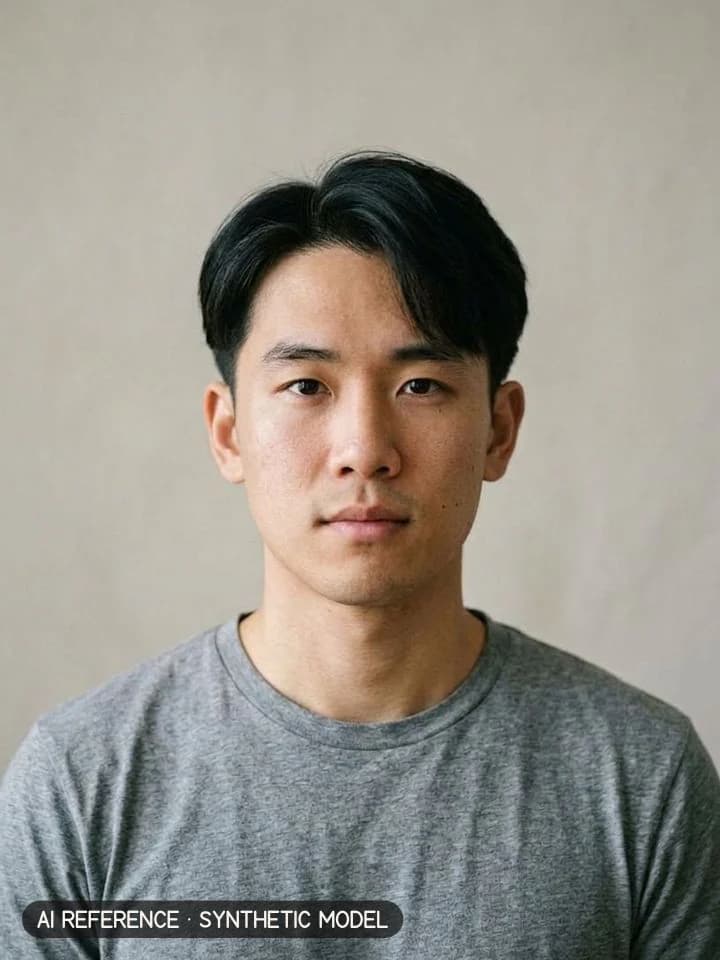 Classic taper (short back & sides)Model M1
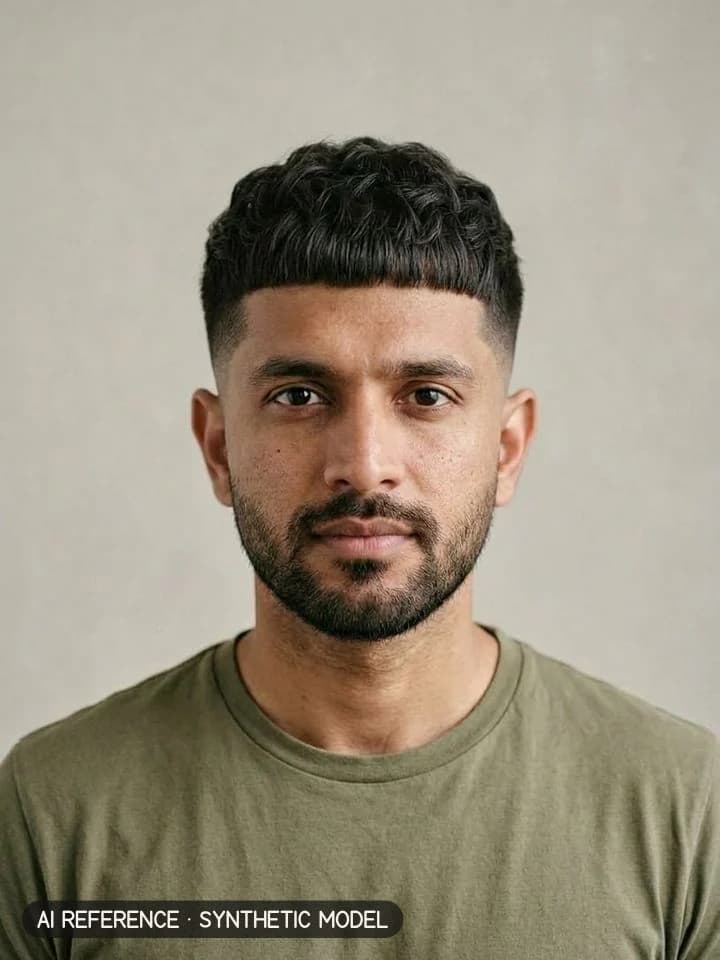 Edgar cutModel M3
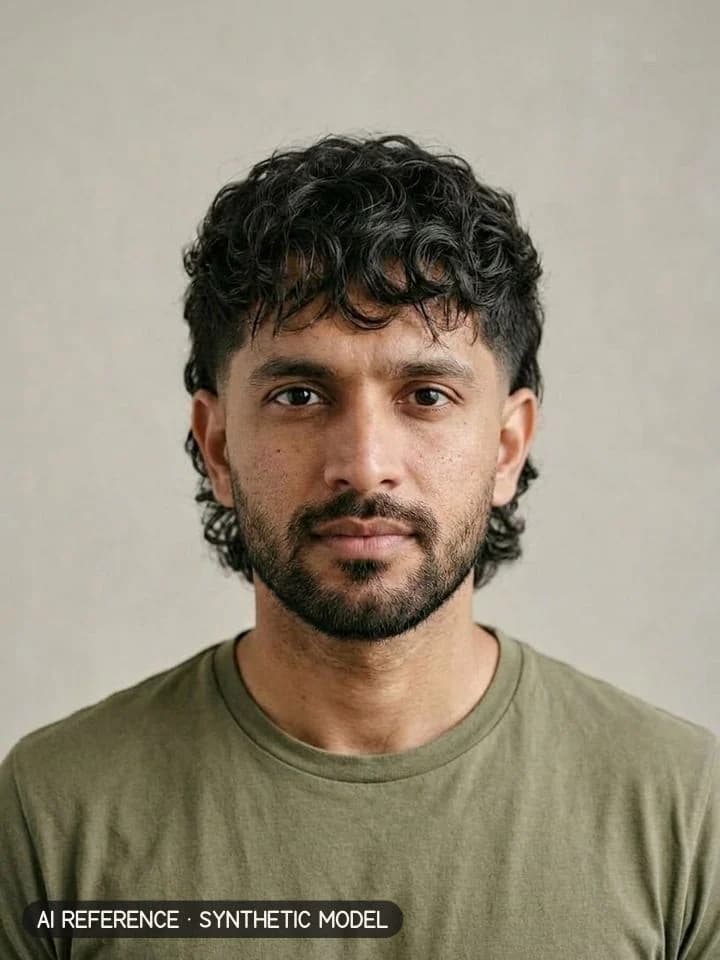 Modern mulletModel M3
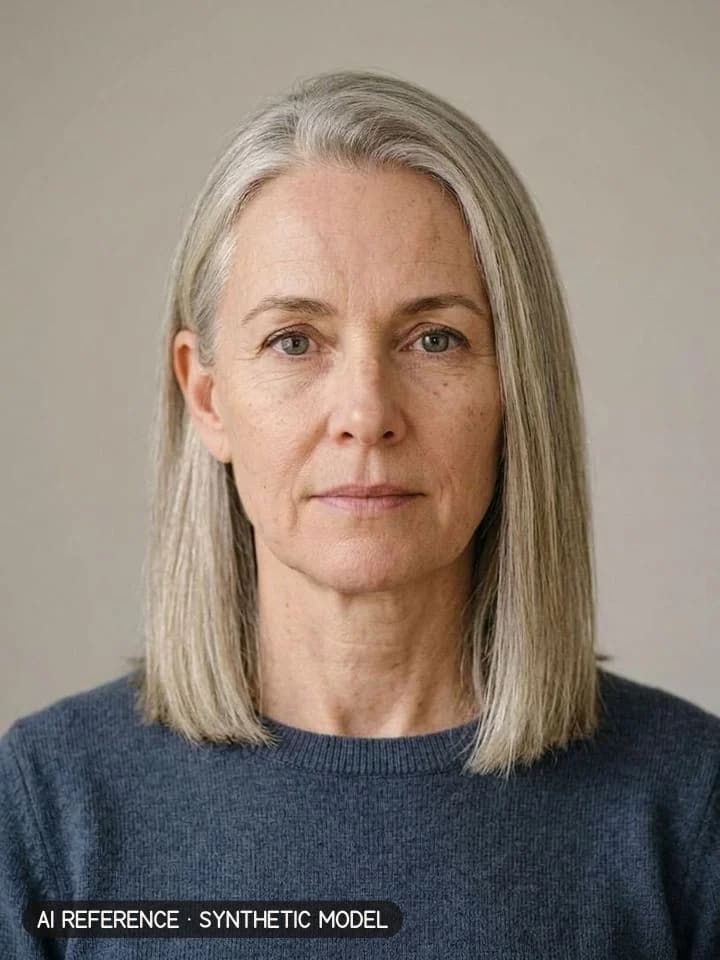 Lob (long bob)Model W2
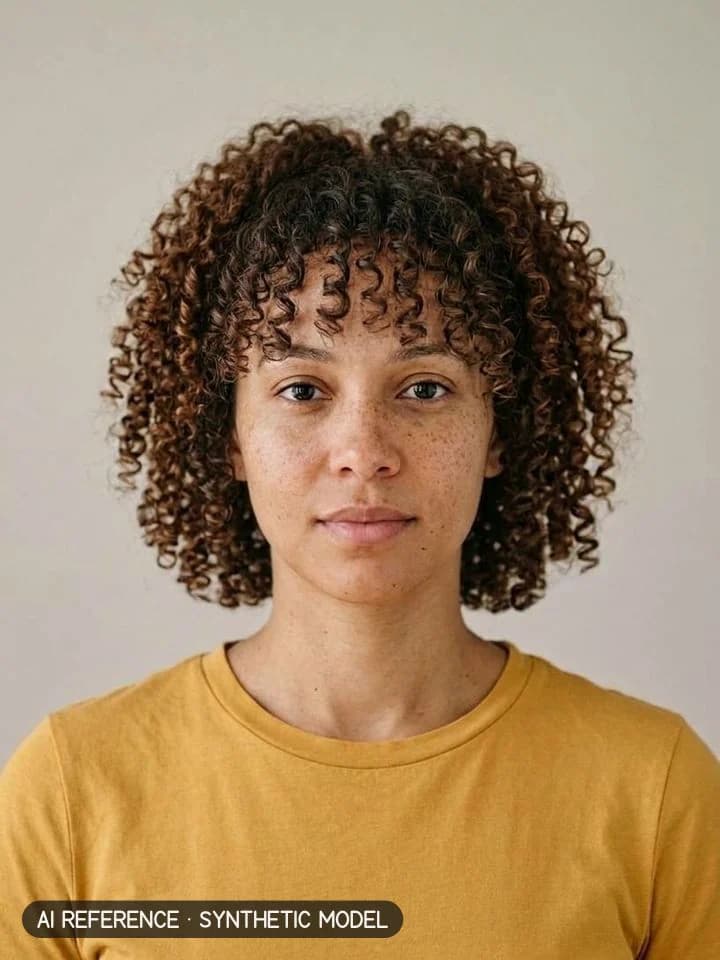 ShagModel W4
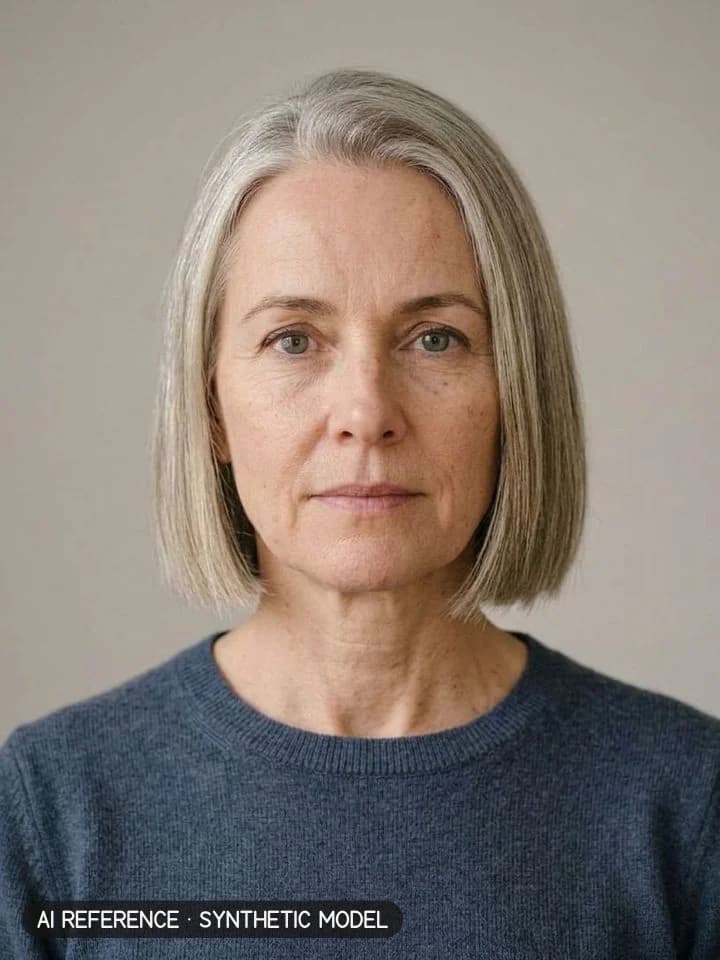 Italian bobModel W2
AI reference on a synthetic model — not a real person. Swipe for more.
Checking by hand
Possible, but people tend to overestimate their face's width and underestimate its length. A photo taken at arm's length also distorts it, so stand back or use a timer.
- 1
Pull your hair back
Forehead, hairline and ears visible. Neutral expression, looking straight ahead.
- 2
Measure four lines
Forehead width, cheekbone width at the widest point, jaw width at the jaw corners, and length from hairline to chin.
- 3
Divide
Length ÷ cheekbone width, and forehead ÷ jaw. Compare with the ranges in the tables above.
- 4
Look at the jaw corner
A sharp angle points to square or triangle; a curved one to round, oval or heart.
Oval face shape: questions
Can an oval face wear any haircut?
What haircuts suit an oval face?
Is oval the ideal face shape?
Why do so many people think they have an oval face?
Is an oval face 1.5 times longer than it is wide?
How do I know if I have an oval face?
Want the list for your hair, not a textbook face?
The free analysis adds your hair type, thickness and hairline and names your best fit, with the reason. Members get every pick explained, on their own face.
Your face is measured on your phone