- Women's cut
- Medium
- TikTok favorite
Wolf cut
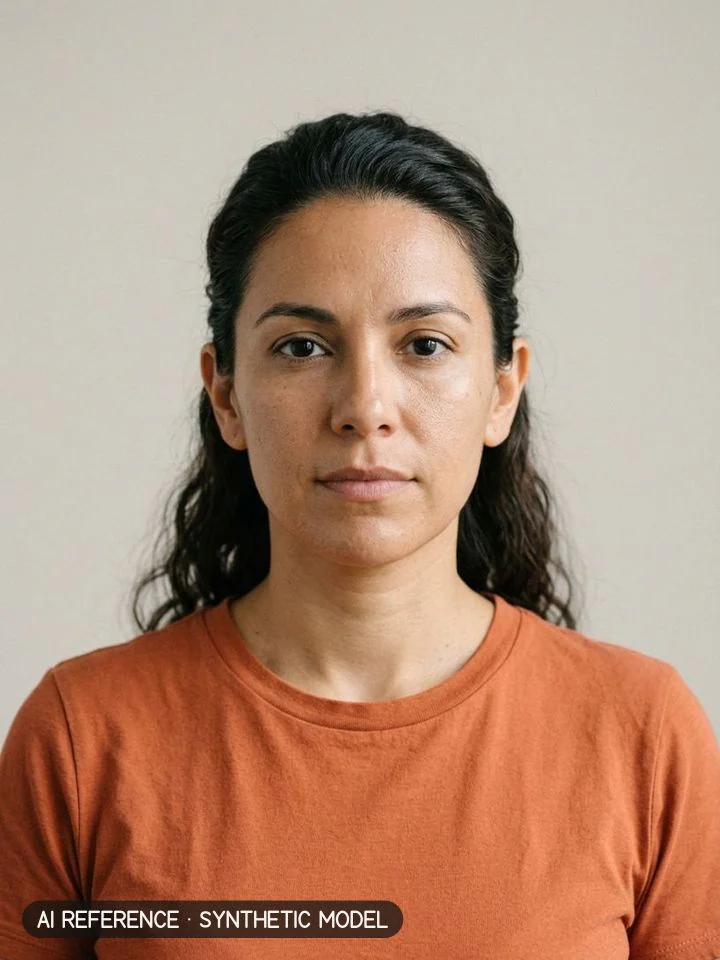
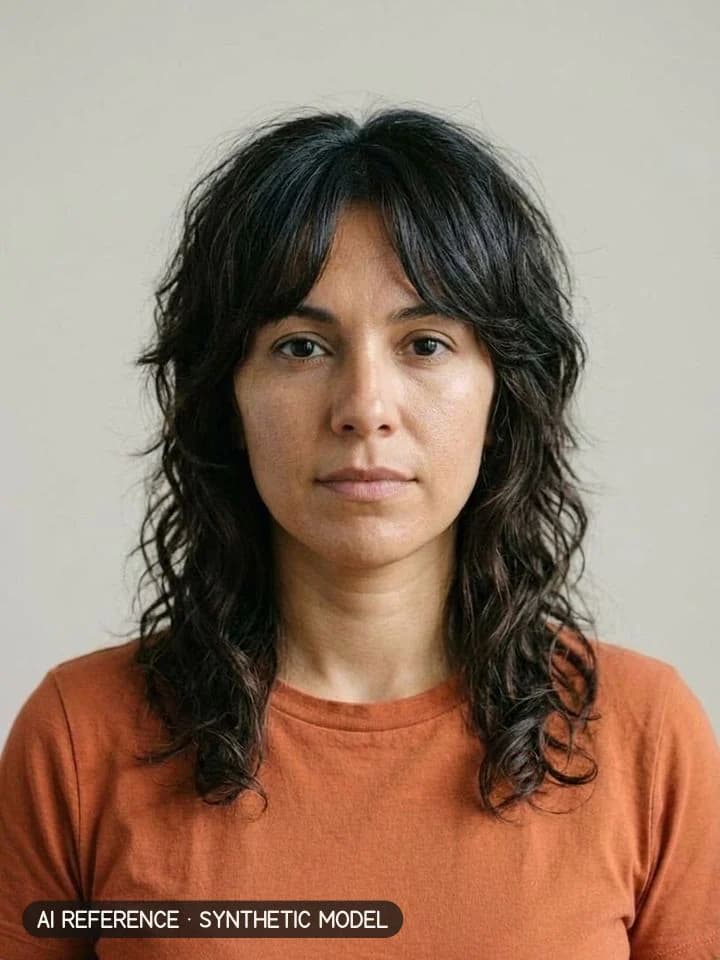
AI reference on a synthetic model — not a real person
A medium, edgy and textured women's cut with 3–5 in (7.5–12.5 cm) on top and a fringe, finished with a tapered neckline.
Also asked for as: wolf haircut, wolf cut women, shaggy mullet, wolf cut hair, wolf cut long hair
Updated
The wolf cut at a glance
- On top
- 3–5 in7.5–12.5 cm
- Best on
- Wavy to curly hair
- Recut
- Every 6–8 weeks
- Styling
- 5–10 min a day
Traditionally suggested for
Heart and oval faces, a long neck, thick wavy hair.
Stylist rule of thumbThe wolf cut on 4 synthetic models
3 skin tones and 3 hair types, each shown only on hair the cut can hold, on men and women. AI reference on a synthetic model — not a real person.
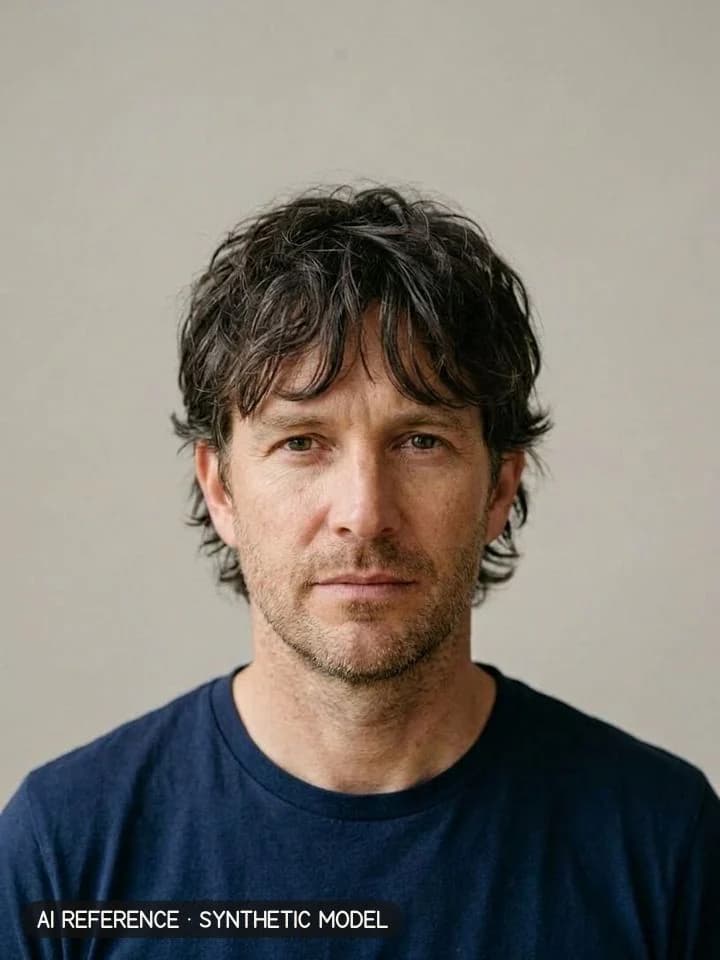
Wolf cut · Model M2fair skin · fine-wavy hair with some gray · 40s 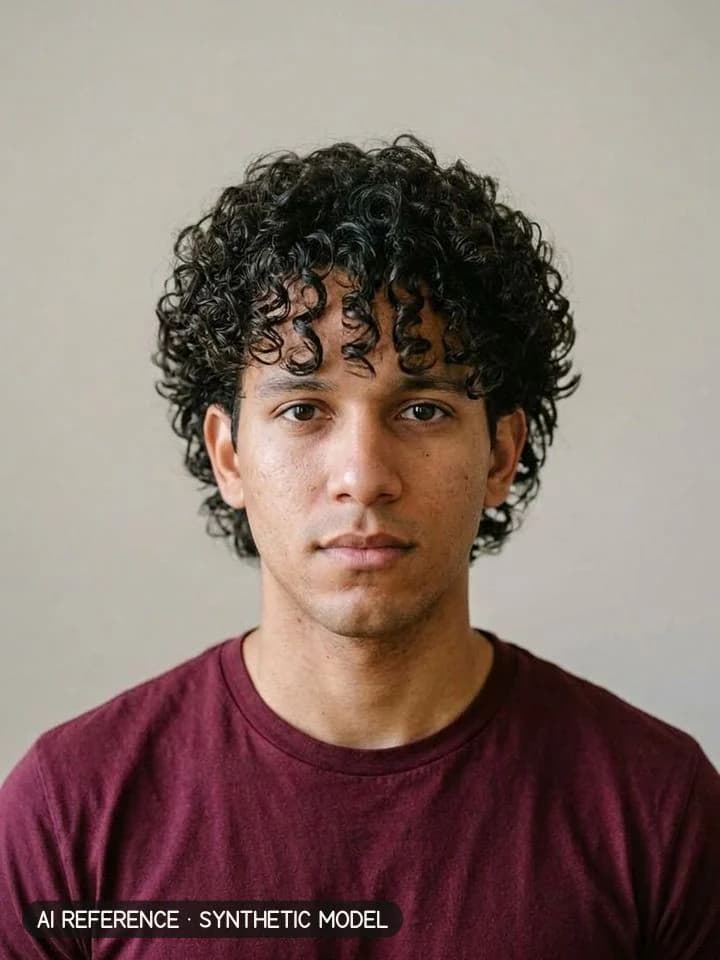
Wolf cut · Model M5light brown skin · curly hair · 20s Wolf cut · Model W3olive skin · wavy hair · 30s 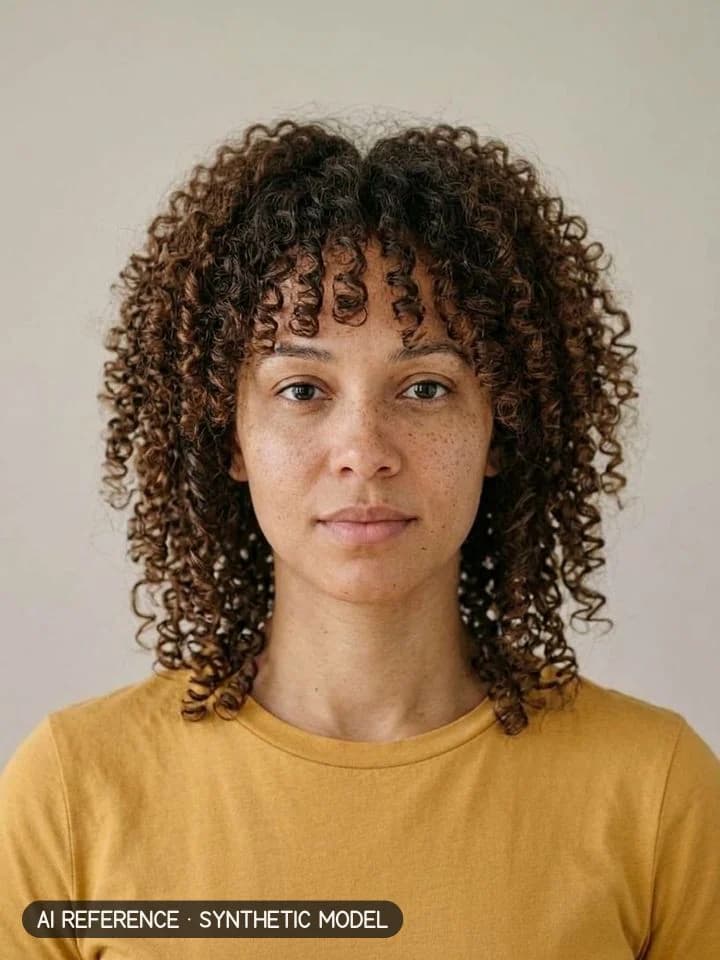
Wolf cut · Model W4light brown skin · curly hair · 20s
AI reference on a synthetic model — not a real person. Each picture starts from one AI-made portrait per model; only the hair is changed, and we publish it only if our check finds the face unchanged. Your own preview uses your photo.
Who it fits
Hair comes first: these decide whether the shape can hold.
- Best on wavy to curly hair.How hair behaves
- Medium to thick hair.How hair behaves
- Still works with a hairline a little higher at the temples.Barbers agree
- Scores higher if you have a high forehead.Stylist rule of thumb
- Scores higher if you have coarse hair.How hair behaves
Who should skip it
Any one of these moves it down your list, or off it.
- Straight and coily hair: the shape needs a texture it can't hold, so we rule it out.How hair behaves
- Low-density hair: the cut relies on bulk that thin hair doesn't have.How hair behaves
- A clearly receding hairline or more: we flag it one step past its limit and stop suggesting it after that.Barbers agree
- Helmets, hats or daily swimming: they flatten the volume the shape needs.How hair behaves
- A conservative workplace: it reads as a statement cut.Stylist rule of thumb
- Scores lower if you have fine hair.How hair behaves
- Scores lower if you have low-density hair.How hair behaves
Barbers also flag: Fine low-density hair, round faces, a conservative look; trend-dependent (Janif 2014: rarer looks rate higher).
Wolf cut vs shag
The wolf cut and the shag share medium length, the same best textures (2A–3B), medium to high density, a recut every 6–8 weeks and the same fringe (curtain bangs), which is why they get mixed up. Below are only the specs where they differ.
| Spec | Wolf cut | Shag |
|---|---|---|
| What the barber cuts | Wolf cut: Heavy crown layers; texturise the lengths; mullet-ish back | Shag: Choppy layers with volume at the crown; cut to air-dry |
| Neckline | Wolf cut: Tapered (fades out naturally) | Shag: Rounded |
| Best on | Wolf cut: 2A–3B hair | Shag: 2A–3B hair, plus 1B with adjustments |
| Daily styling | Wolf cut: 5–10 min a day | Shag: 5–15 min a day |
| Also needs | Wolf cut: Volume at the crown and a dress code that allows a statement cut | Shag: Volume at the crown |
| Top 3 on proportions | Wolf cut: No shape in the top 3 | Shag: Oval, heart, diamond and triangle |
| Traditionally suggested for | Wolf cut: Heart and oval faces, a long neck, thick wavy hair. | Shag: Square or angular faces (softens), oblong faces (side width), diamond faces, thick hair. |
Every row is a catalog field or our engine’s geometry ranking; “traditionally suggested for” is stylist convention. Which of the two suits you comes down to your own texture, density and hairline: check your hair for free, or read the full shag spec.
Wolf cut vs butterfly cut
People search the wolf cut and the butterfly cut together; on spec the two share medium to high density. Below are only the specs where they differ.
| Spec | Wolf cut | Butterfly cut |
|---|---|---|
| What the barber cuts | Wolf cut: Heavy crown layers; texturise the lengths; mullet-ish back | Butterfly cut: Keep the length; long layers; cut for round-brush blowouts |
| Length on top | Wolf cut: 3–5 in (7.5–12.5 cm) | Butterfly cut: 6–8 in (15–20.5 cm) |
| Fringe | Wolf cut: Curtain bangs | Butterfly cut: Face-framing layers starting at the cheekbone |
| Neckline | Wolf cut: Tapered (fades out naturally) | Butterfly cut: Rounded |
| Best on | Wolf cut: 2A–3B hair | Butterfly cut: 1B–2C hair |
| Recut | Wolf cut: Every 6–8 weeks | Butterfly cut: Every 8–10 weeks |
| Daily styling | Wolf cut: 5–10 min a day | Butterfly cut: 10–20 min a day |
| Also needs | Wolf cut: Volume at the crown and a dress code that allows a statement cut | Butterfly cut: Volume at the crown, a blowout in humid weather and heat tools |
| Top 3 on proportions | Wolf cut: No shape in the top 3 | Butterfly cut: Square, heart and triangle |
| Traditionally suggested for | Wolf cut: Heart and oval faces, a long neck, thick wavy hair. | Butterfly cut: Long hair with volume; round faces (framing lines lead the eye down), square faces. |
Every row is a catalog field or our engine’s geometry ranking; “traditionally suggested for” is stylist convention. Which of the two suits you comes down to your own texture, density and hairline: check your hair for free, or read the full butterfly cut spec.
What to tell your barber
The catalog spec, in barber terms. Your own card adjusts it: the part side from your crown, notes for your hair type, and a QR code your barber can open.
Read this to your barber
“Heavy crown layers; thinned-out lengths; mullet-ish back; curtain bangs.”
- Sides
- Heavy crown layers; thinned-out lengths
- Top
- 3–5 in (7.5–12.5 cm)
- Fringe
- Curtain bangs
- Neckline
- Tapered (fades out naturally)
- Technique
- Heavy crown layers; texturise the lengths; mullet-ish back
- Product
- Texture spray or mousse
- Recut
- Every 6–8 weeks
Get the look
Products and tools for the wolf cut
Product types, not brands, picked from the barber spec above and split by hair type. Your own results match them to your hair.
We may earn a commission if you buy through these links; it doesn't change what we recommend.
Wavy hair
- Dry texture sprayThe barber spec's texture spray gives the choppy crown its piecey volume.Amazon(opens a search in a new tab)
- Volumizing mousseMousse, the spec's alternative, lifts the crown layers from the root.Amazon(opens a search in a new tab)
- Diffuser attachmentA diffuser dries the layers in their natural shape.Amazon(opens a search in a new tab)
Curly hair
Upkeep and yearly cost
Priced at $30 a cut. Your results use your own local price.
- Trim every
- 6–8 weeks
- Per year
- 7–9 cuts a year, about $210–$270 at $30 a cut
- Daily styling
- 5–10 min a day
- Product
- Light product
- Heat tools
- Not needed
Proportions, by face shape
Where the wolf cut places in our engine’s top 10 for a textbook face of each shape, on proportions alone. Proportions are the smallest part of a real score; your hair counts for more.
Guides that mention the wolf cut
- Butterfly cut vs wolf cut vs shag vs long layersWhere the layers start on a butterfly cut, wolf cut, shag and long layers, which hair each one needs, how much heat and styling it takes, and what to ask for.
- Wolf cut vs mullet vs mod cut: how they differHow a wolf cut, modern mullet, mod cut and shag differ at the back, sides and fringe, which hair and hairline each needs, and what to tell your barber.
Wolf cut: questions
What do I ask my barber for with a wolf cut?
Wolf cut vs shag: what's the difference?
Wolf cut vs butterfly cut: what's the difference?
Is the wolf cut a women's cut?
Does the wolf cut work on curly or coily hair?
Does the wolf cut work on thin or fine hair?
How much upkeep does a wolf cut need?
Who should skip the wolf cut?
Is a wolf haircut the same as a wolf cut?
Will the wolf cut fit you? Find out before you sit down.
We check it against your face and hair. Your best cut is free, shown on your own face. Members see every cut that fits, with the numbers for your barber.
Your face is measured on your phone